

TLDR:
- 35% of websites have critical technical issues preventing proper crawling or indexing of important content. Most of those businesses have no idea. They are publishing content into a site Google cannot fully read.
- 68% of all published pages receive zero organic traffic, and the majority of those failures trace back to fixable technical issues rather than content quality or competition.
- 73% of websites have orphaned pages, meaning pages with no internal links pointing to them that search engines struggle to discover. That content does not rank because Google does not know it exists.
- Google’s March 2025 core update elevated Core Web Vitals from a tiebreaker signal to a primary ranking factor for competitive queries. Sites scoring in the “Needs Improvement” range for Interaction to Next Paint dropped an average of 6.2 positions within 60 days.
Most businesses think about SEO in terms of content and keywords. They write posts, target phrases, build pages. What they almost never examine is the infrastructure underneath all of it: whether Google can actually access the content, whether it can crawl it efficiently, and whether the technical signals the site is sending are helping or actively working against rankings.
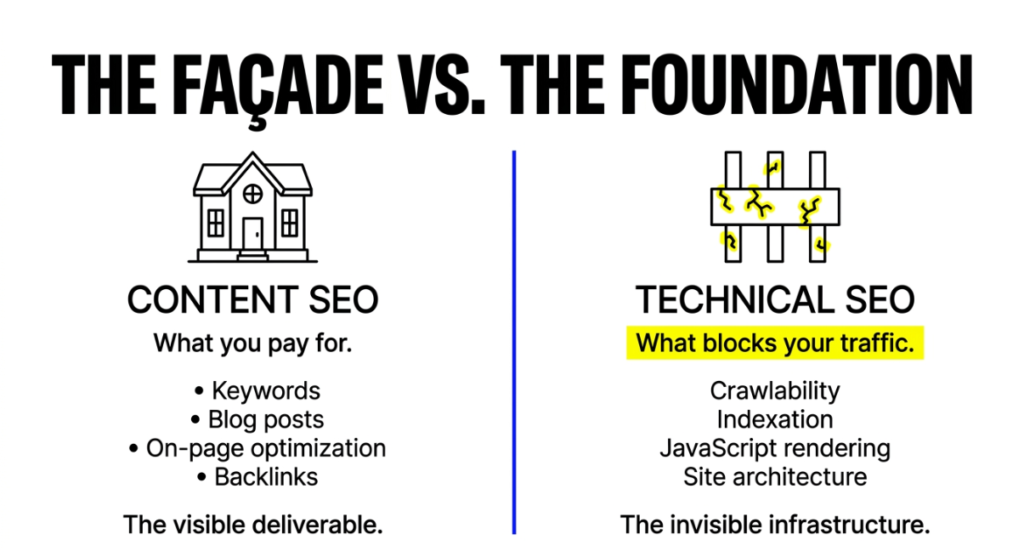
Technical SEO is unglamorous. It does not produce a visible deliverable the way a new blog post does. Most agencies underinvest in it because clients cannot easily see it happening and it is harder to report on. The result is that a significant portion of published content is either invisible to search engines, crawled too infrequently to rank competitively, or sending contradictory signals that suppress the pages around it.
This is the part of SEO that does not appear in the monthly ranking report until the site starts losing ground it had no obvious reason to lose.
What Crawlability Problems Actually Look Like and Why They Are So Common
A site crawlability problem means Google cannot reliably access the content on the website. That can happen several ways, and most of them are not obvious from the front end. A misconfigured robots.txt file can block crawlers from entire sections of a site while the pages look perfectly normal to a visitor. A broken XML sitemap means Google is not receiving the clean roadmap of what exists on the site. A robots meta tag set to “noindex” on a page that was once in staging and never corrected will suppress that page from search results indefinitely.
Fixing critical crawl errors increases organic traffic by 20 to 35% within three to six months on average. That figure reflects what happens when previously blocked or undiscovered content finally becomes accessible to search engines. It is not a content improvement. It is the existing content being allowed to compete for the first time.
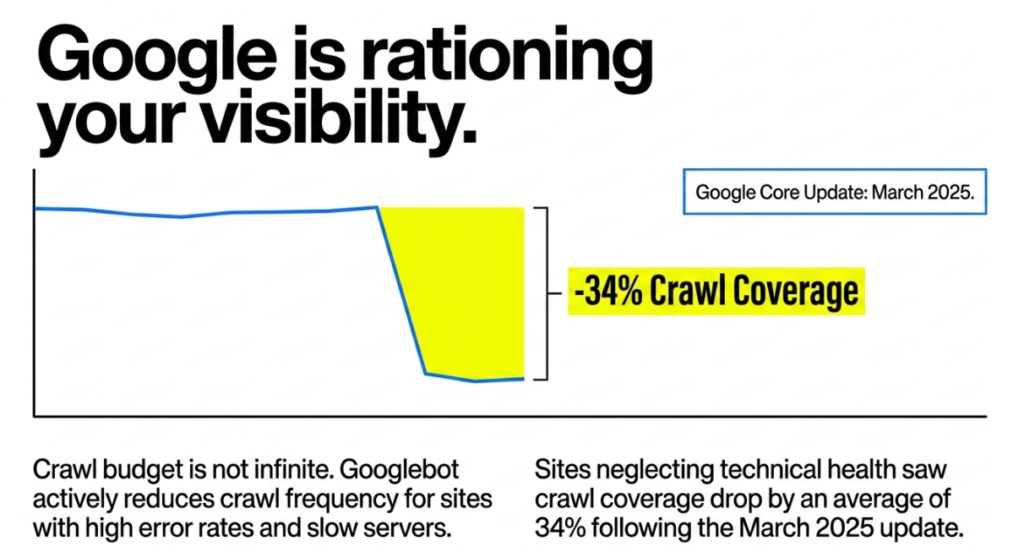
In March 2025, Google confirmed that Googlebot reduced crawl frequency for sites with high crawl error rates and slow server response times. Sites that had not audited their technical health in twelve months saw crawl coverage drop by an average of 34%. Crawl budget is not infinite, and Google is increasingly selective about where it spends it. A site full of technical noise forces Googlebot to spend its budget on the wrong pages and leave the important ones undercrawled and underindexed.
The Orphaned Pages Problem Nobody Talks About Until Rankings Disappear
73% of websites have orphaned pages. An orphaned page is one with no internal links pointing to it. Search engines discover pages primarily by following links. A page that exists on the server but has no links pointing to it from anywhere else on the site is invisible to crawlers unless the URL appears in a sitemap. And even then, without internal links, it carries no authority and ranks poorly if at all.
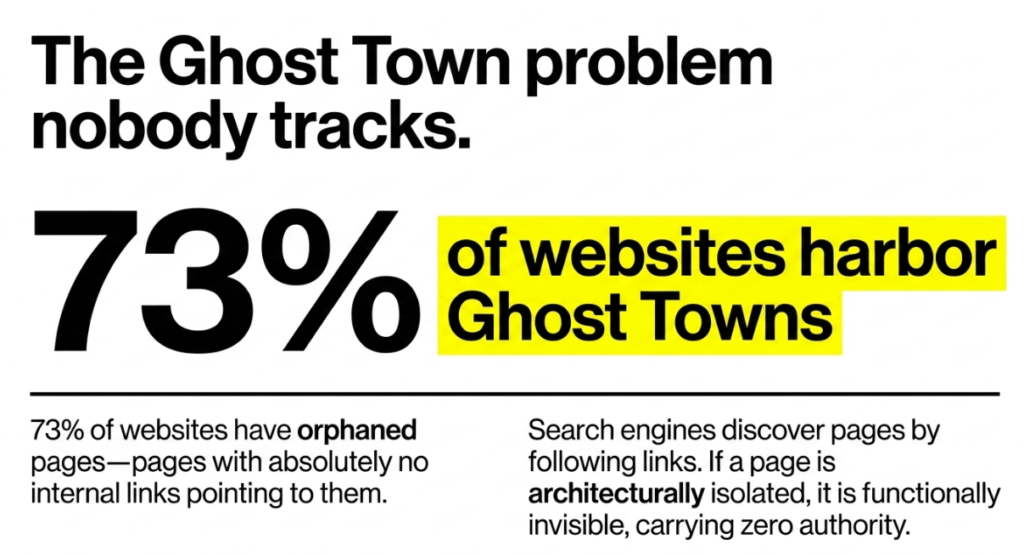
This problem is more common than most businesses realize because it develops gradually. A page gets published, it links out but nothing links to it, and it never gets connected properly into the site architecture. Over time a site accumulates dozens of these orphaned pages. The content may be strong. The keyword targeting may be correct. None of it matters if the page is architecturally isolated from the rest of the site.
Pages that require more than three clicks to reach from the homepage are 75% less likely to be crawled frequently and rank well. Internal linking is not just a navigation decision. It is a crawl priority signal. Pages that are closer to the homepage in the link structure and that receive links from multiple other pages within the site are treated as more important by search engines. Orphaned pages receive the opposite treatment. A technical audit surfaces these pages and the fix is straightforward: add contextually relevant internal links from existing pages that are already being crawled.
What Core Web Vitals Actually Measure and Why the Goalposts Shifted
Core Web Vitals are Google’s page experience signals: Largest Contentful Paint measures how long it takes for the main content of a page to load. Cumulative Layout Shift measures how much the page visually jumps around as it loads. Interaction to Next Paint measures how responsive the page is to user input after the initial load. Google’s March 2025 core update elevated these from a secondary ranking consideration to a primary ranking factor in competitive queries. Sites scoring in the “Needs Improvement” range for Interaction to Next Paint specifically dropped an average of 6.2 positions within 60 days of that update.
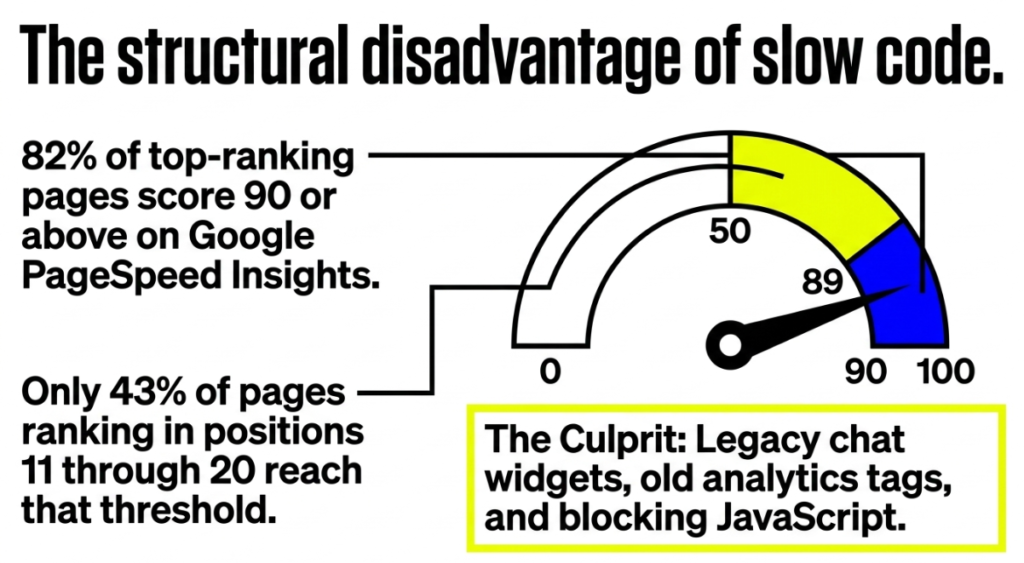
82% of top-ranking pages score 90 or above on Google PageSpeed Insights. Only 43% of pages ranking in positions 11 through 20 reach that threshold. The correlation between page experience scores and rankings is not a coincidence. Google is explicit that it wants to send users to pages that load fast, are stable, and respond quickly to interaction. Pages that fail those benchmarks are competing at a structural disadvantage regardless of how good the content is.
The most common Interaction to Next Paint failures trace to JavaScript-heavy pages where third-party scripts run on load and block the main thread. Legacy chat widgets, old analytics tags, advertising scripts, social sharing buttons, and marketing tool pixels all contribute to this problem. Many of them were added for legitimate reasons and never revisited. A technical audit identifies which scripts are contributing to page slowness and allows them to be deferred, removed, or replaced.
Redirect Chains and Duplicate Content Issues That Drain Link Authority
Redirect chains occur when a URL redirects to a second URL that redirects to a third. Each hop in the chain introduces latency and dilutes the link authority passing through the redirect. A page with strong backlinks that has been through two or three consecutive redirects is passing a fraction of the authority those links are intended to convey. The fix is collapsing the chain so that each URL redirects directly to the final destination in a single step.
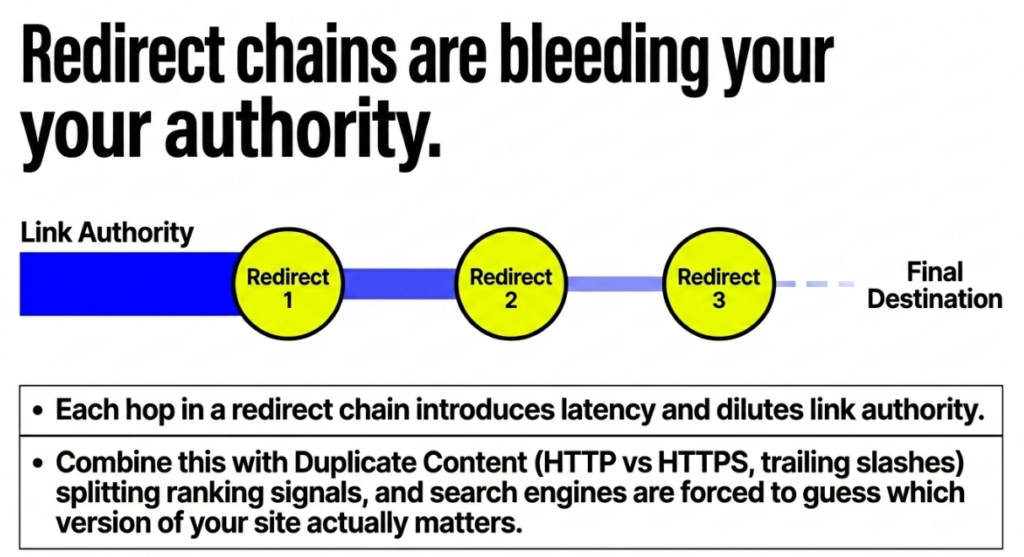
Duplicate content is a more consequential version of the same problem. When multiple URLs serve essentially the same content, search engines have to decide which version to rank. Without a canonical tag pointing to the preferred version, Google makes that call independently, and it does not always choose correctly. A site can have multiple versions of itself, HTTP versus HTTPS, trailing slash versus no trailing slash, www versus non-www, all accessible simultaneously. Each variation can be indexed as a separate page, splitting the ranking signals that should be consolidated on one URL.
Only 31% of websites implement structured data of any kind. Pages with properly implemented schema markup appear in rich results 43% more often than pages without it, and rich results receive 30% higher click-through rates than standard organic results. Structured data is not a ranking factor in the traditional sense. It is a communication layer that tells Google precisely what a page contains, which improves how that page is presented in search results and increases the traffic it receives at a given ranking position.
What a Useful Technical SEO Audit Actually Produces
A technical SEO audit is not a list of every issue a crawl tool found. A crawl of a mid-size website can surface thousands of flagged items, most of which are low priority. The output that matters is a prioritized list of issues ranked by their expected impact on rankings, crawlability, and traffic. High-priority items include anything blocking indexation, significant Core Web Vitals failures, redirect chains passing link authority through multiple hops, broken internal links on important pages, and pages with no canonical tags that are being indexed in multiple versions.
The second deliverable a useful audit produces is a realistic timeline for remediation. Technical fixes are not equal in complexity. Some, like submitting a corrected sitemap or fixing a robots.txt error, take minutes. Others, like resolving site-wide JavaScript rendering issues or rebuilding a URL structure after a poorly executed migration, require developer involvement and staged implementation. An audit that does not distinguish between these categories leaves the business with a list it cannot act on.
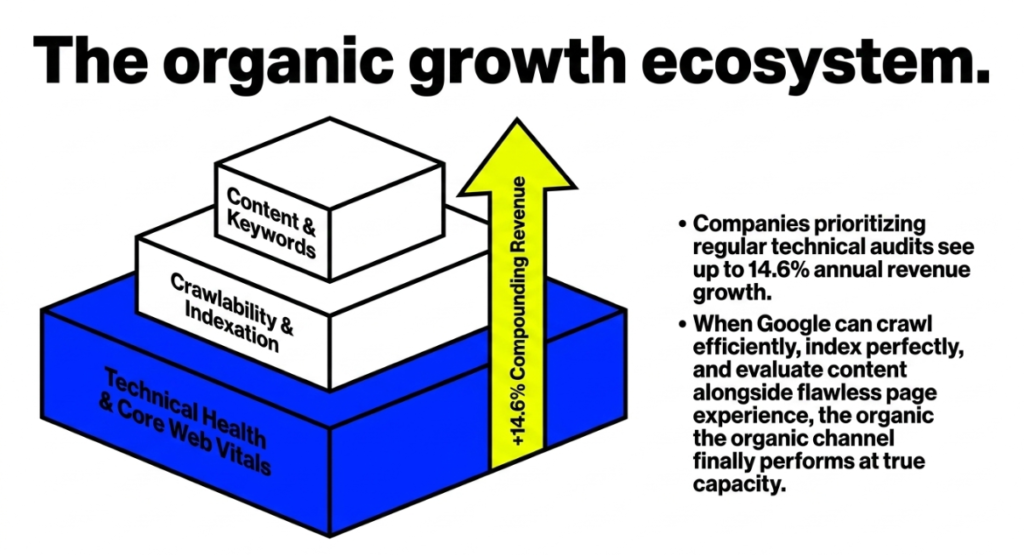
Companies that prioritize regular technical SEO audits see up to 14.6% annual revenue growth after fixing the identified issues. That figure is a compounding effect. When Google can crawl the site efficiently, index the right pages, and evaluate content alongside strong page experience signals, the organic channel performs at its actual capacity rather than at a fraction of it. Big Click Energy approaches technical audits as the prerequisite to every other SEO investment, because content strategy built on a broken technical foundation is content that will not rank at the rate it should.
FAQ
What is a technical SEO audit and what does it cover?
A technical SEO audit is a systematic review of a website’s infrastructure to identify issues that prevent search engines from crawling, indexing, or ranking pages correctly. It covers crawlability and indexation, page speed and Core Web Vitals, internal linking structure, redirect chains and canonicalization, HTTPS status, XML sitemap health, structured data implementation, and mobile usability. The audit’s goal is not to generate a list of every imperfection but to identify the issues that are most directly suppressing organic traffic and rankings.
How often should a technical SEO audit be done?
A full technical audit at least once per year is a reasonable minimum, with a lighter automated crawl running monthly to catch new issues between full reviews. Any significant site event should trigger an immediate audit: a platform migration, URL restructure, CMS update, or the addition of a new subdomain. Waiting for a monthly reporting cycle after a platform migration has cost businesses up to 60% of their organic traffic before anyone investigated the cause.
What is crawl budget and why does it matter for SEO?
Crawl budget is the number of pages Google will crawl on a site within a given timeframe. It is not infinite. Sites with high crawl error rates, duplicate content, redirect chains, and large volumes of low-value pages cause Googlebot to waste its budget on the wrong pages and crawl the important ones less frequently. Google’s March 2025 update confirmed that sites with persistently high crawl error rates saw their crawl coverage drop by an average of 34%. Optimizing crawl budget means removing or blocking low-value URLs and making the site’s most important pages easy and efficient to crawl.
What are Core Web Vitals and do they affect rankings?
Core Web Vitals are Google’s three page experience metrics: Largest Contentful Paint for loading speed, Cumulative Layout Shift for visual stability, and Interaction to Next Paint for responsiveness. Google’s March 2025 core update elevated them to a primary ranking factor in competitive queries. Sites scoring in the “Needs Improvement” range specifically for Interaction to Next Paint dropped an average of 6.2 positions within 60 days. 82% of top-ranking pages score 90 or above on Google PageSpeed Insights versus only 43% of pages in positions 11 through 20.
What is the difference between a technical SEO audit and a regular SEO audit?
A regular SEO audit typically covers keyword rankings, content quality, on-page optimization, and backlink profiles. A technical SEO audit focuses specifically on the infrastructure layer: how search engines access, crawl, render, and index the site. Both are necessary. Content strategy built on a site with technical problems will underperform because the content cannot be discovered or evaluated correctly. Technical optimization built around poor content or weak positioning will produce better crawling of content that still does not rank. The two categories address different parts of the same system and both require regular attention.