
TLDR:
- Click fraud affects up to 90% of PPC campaigns and accounts for 10 to 20% of total ad spend losses. Most agencies are not actively monitoring for it, and most clients never ask.
- 15% of digital ad spend disappears somewhere in the supply chain according to industry studies cited in the European Commission’s ruling against Google’s ad tech practices. Opacity is not an accident. It is a structural feature of how the industry works.
- Agencies charging a percentage of ad spend have a documented conflict of interest: higher spend means a higher fee, regardless of whether the spend is producing results. Most clients sign these contracts without recognizing the misalignment.
- If your ad platform reports 200 conversions and your CRM shows 45 new customers, something fundamental is broken in your attribution, and your campaigns are being optimized toward numbers that do not reflect your actual business.
Most businesses hand over their ad accounts and then wait for a monthly report. The report shows impressions, clicks, CTR, and cost per conversion. The numbers look active. The agency looks busy. And somewhere between the dashboard and the bank account, the connection between ad spend and actual revenue is never clearly drawn.
This is not always dishonesty. Sometimes it is structural misalignment. Sometimes it is an agency that is competent at managing the platform but has never been asked to connect platform performance to business outcomes. And sometimes it is an agency that figured out a long time ago that a client who does not know what to look for is easier to keep than a client who does.
The way to tell the difference starts with knowing what a well-managed account looks like versus what a neglected one looks like, and what questions to ask that do not have a prepared answer waiting for them.
The Percentage-of-Spend Model and the Conflict It Creates
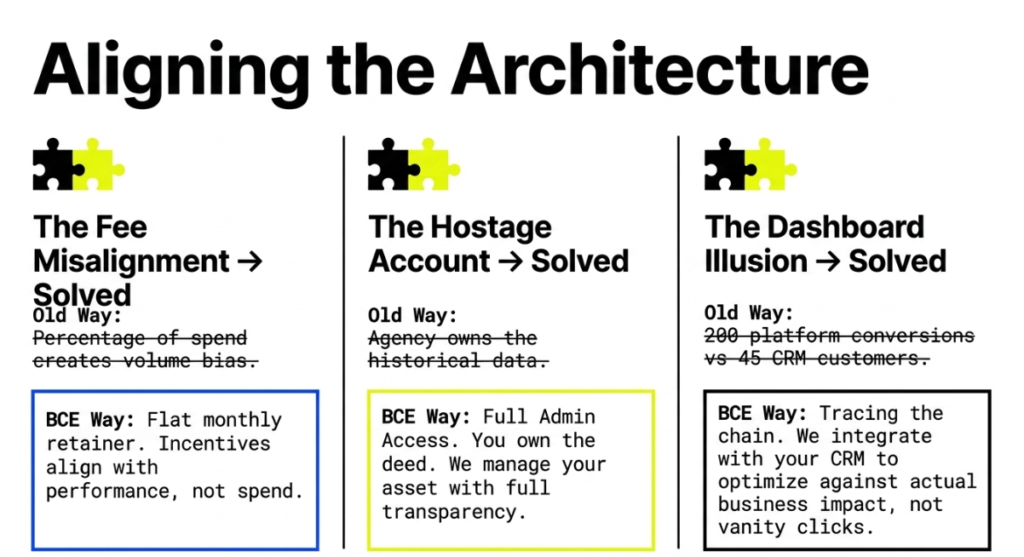
Most ads agencies charge either a flat monthly retainer or a percentage of ad spend, typically between 10 and 20 percent. The flat retainer aligns incentives reasonably well. The percentage model does not, and most clients sign it without recognizing the problem.
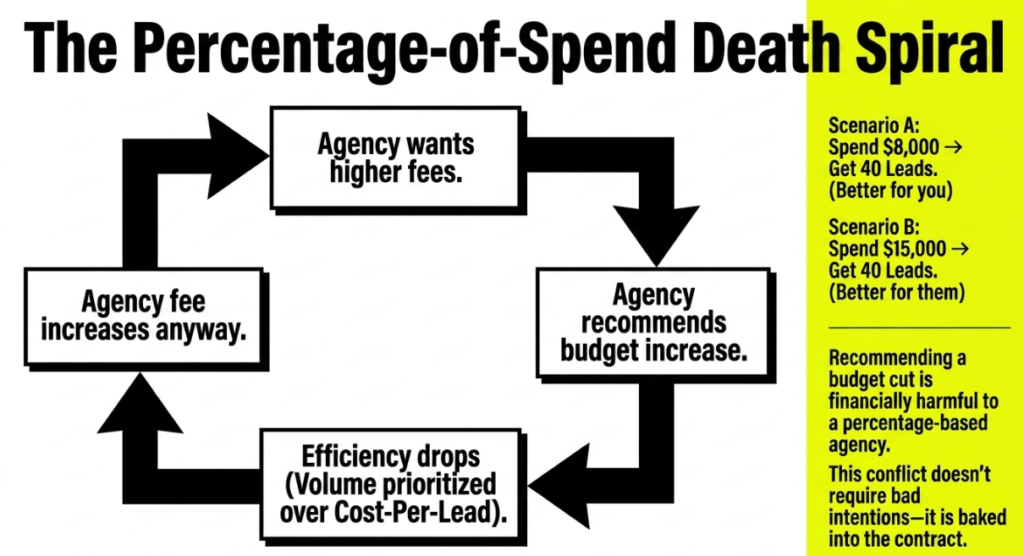
When an agency earns more as spend increases, efficiency is not the priority. Volume is. A campaign that spends $15,000 per month and produces 40 leads is more valuable to a percentage-based agency than a campaign spending $8,000 that produces the same 40 leads at half the cost. Recommending the budget cut is financially harmful to the agency. Recommending a budget increase is financially beneficial. Neither recommendation is grounded in what the data actually supports for the client’s business.
This conflict does not require bad intentions to produce bad outcomes. It is a structural problem baked into the fee model. The businesses most exposed to it are those that do not track cost per acquired customer independently of what the agency reports, because they have no way to verify whether budget increases are producing proportional revenue increases or simply producing proportional fee increases.
What the Reporting Is Hiding When Nobody Checks
Platform-reported conversions and actual business results are not the same number, and the gap between them is where most budget accountability breaks down. If your ad platform reports 200 conversions last month and your CRM shows 45 new customers, something fundamental is broken in your attribution setup. Campaigns are being optimized toward the 200. The business is only receiving the benefit of the 45.
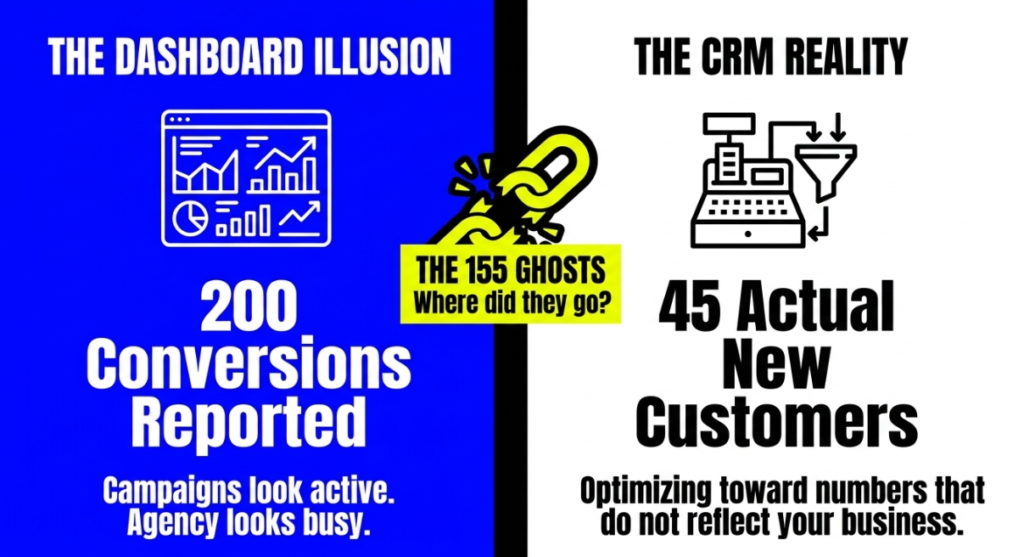
This gap is common. Double-firing pixels inflate conversion counts when a confirmation page loads twice. iOS privacy changes have degraded Meta’s ability to track conversions, leaving platforms to report estimated results that consistently run higher than actual outcomes. Last-click attribution assigns full credit to the final touchpoint before conversion and ignores every earlier interaction, which produces a distorted picture of which campaigns are working and which are not.
The clearest signal that reporting is hiding something is the mismatch between platform numbers and business outcomes. Ask your sales team how many of last month’s leads were from paid ads, how many of those conversations went anywhere, and what the close rate looks like. Then compare that against what the dashboard says. If the platform is reporting a cost per lead of $45 and your team cannot identify where any real customers came from, the tracking is telling a different story than the business is experiencing.
What Active Campaign Management Actually Looks Like
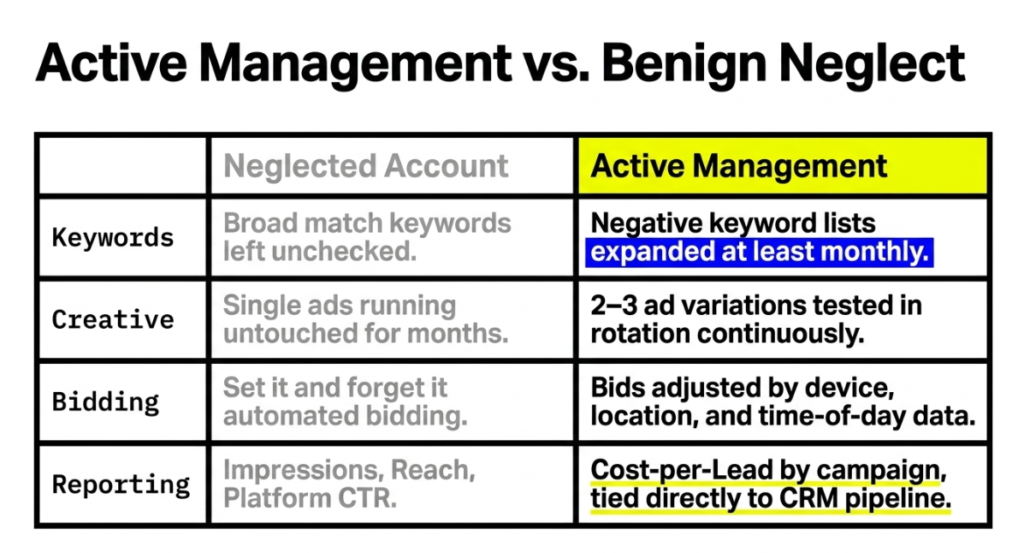
An agency actively managing paid campaigns is doing specific things at regular intervals that are visible in the account history. Negative keyword lists are reviewed and expanded at least monthly. Broad match keywords that are generating irrelevant search terms are identified and either converted to phrase or exact match, or removed. Ad creative is tested in rotation with at least two or three variations running simultaneously. Bid adjustments are made based on device, location, and time-of-day performance data. Quality Scores are monitored, because a Quality Score below 7 out of 10 means the business is paying more per click than well-managed competitors for the same ad position.
The average CTR for Google Search Ads in 2025 is 6.66%. Campaigns consistently running below 4% are paying for impressions that are not producing engagement, which signals a disconnect between the keywords being targeted and what users are actually searching for. An agency that cannot explain why CTR is below that threshold or what changes are being made to address it is not actively managing the account.
One of the clearest diagnostic questions to ask is: can I see the search terms report from the last 90 days? This report shows exactly what users were searching when the ads triggered. Broad match keywords can cause ads to appear for searches that have nothing to do with the business. Irrelevant searches cost the same per click as relevant ones. If the search terms report contains obvious mismatches, negative keywords have not been maintained, and budget has been draining into the wrong traffic for months.
The Account Ownership Issue Nobody Mentions at Signing
Businesses that do not own their own ad accounts are in a position of complete dependency that is almost never explained in a sales conversation. When an agency creates and manages the ad account under their own umbrella, the historical data, the audience lists, the conversion history, and the campaign structure all belong to the agency. If the relationship ends, the account stays with them. The business starts over from zero, including rebuilding the conversion data that Google’s algorithm uses to optimize targeting.
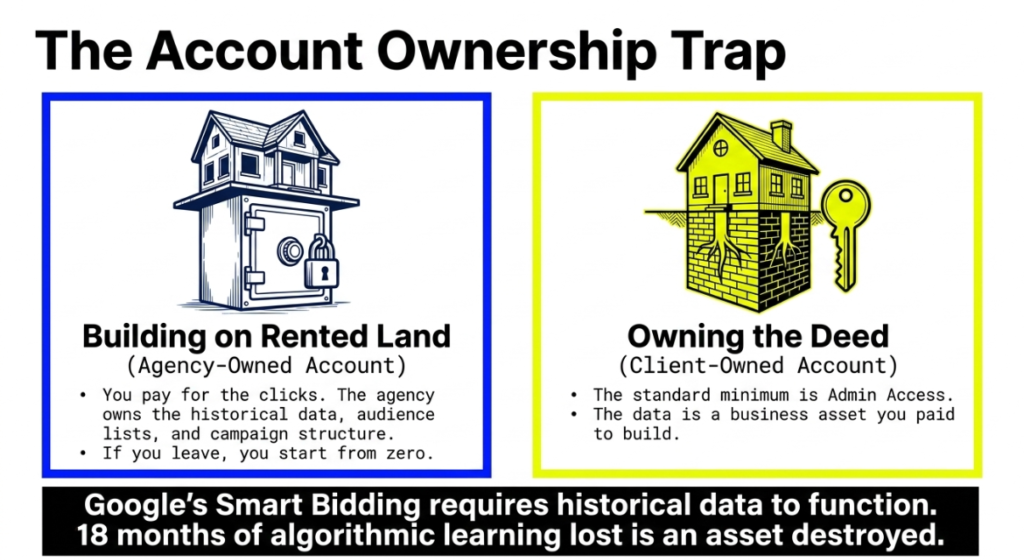
This matters because Google’s Smart Bidding strategies require conversion history to function effectively. An account with 18 months of data, conversion signals, and audience segments is fundamentally different from a new account with no history. A business that discovers its account belongs to the agency after years of paying for it is not just losing a vendor. It is losing an asset it paid to build.
The standard minimum is read access to the account at all times. A reputable agency has nothing to hide and will add the client as an account administrator. An agency that resists granting access to the account the client is paying to run is protecting something, and that protection is almost never in the client’s interest.
What a Legitimate Ads Agency Reporting Structure Looks Like
Good reporting connects platform metrics to business outcomes. It is not a dashboard screenshot with a paragraph about impressions. It shows cost per lead by campaign, conversion rate by landing page, lead quality feedback from the sales team integrated into optimization decisions, and a clear comparison of spend to revenue that does not require the client to do their own math.
A legitimate agency will proactively flag when something is not working and bring a recommendation to fix it before the monthly call. They will show the search terms that triggered ads and explain what action was taken on irrelevant traffic. They will update the client when a creative is fatiguing and present tested alternatives. They will explain negative decisions, like why a particular keyword was paused, in terms of business impact rather than platform metrics.
Big Click Energy manages ad accounts with the client’s full access, full visibility, and reporting that starts from revenue and works backward. Platform numbers are context. Business outcomes are the deliverable. For businesses that have been receiving monthly reports full of activity metrics while wondering where the leads are, the gap between those two things is usually the entire explanation.
FAQ
How do I know if my ads agency is doing a good job?
The clearest test is whether you can connect ad spend to actual revenue through a clear, traceable chain. If the agency reports platform conversions but your CRM or sales team cannot confirm corresponding customers, the tracking is broken and the optimization is pointed at the wrong target. A well-managed account will also show a maintained negative keyword list, active creative testing with multiple ad variations, a CTR above 4% for search campaigns, and regular changes in the account history that reflect ongoing optimization rather than a campaign left to run untouched.
Should I have access to my own Google Ads account?
Yes, always. You should have admin access to any ad account being run on your behalf. The account, its historical data, audience lists, and conversion tracking all represent business assets built with your budget. If the account is owned by the agency, that data leaves with them when the relationship ends, and your next agency starts with no historical signals. Any agency that resists providing admin access to an account you are paying for is protecting their own position, not yours.
What is a percentage-of-spend model and why does it matter?
A percentage-of-spend model charges the agency a fee based on a percentage of your total ad spend, typically 10 to 20 percent. This creates a direct financial incentive for the agency to increase your budget rather than improve efficiency, because a larger budget produces a larger fee regardless of whether the incremental spend is generating returns. The alternative is a flat monthly retainer, which removes that incentive and aligns the agency’s interest with performance rather than volume.
What should I look for in a monthly ads report?
A legitimate ads report should show cost per lead broken down by campaign, conversion rates by landing page or offer, lead quality feedback from your sales team reflected in campaign decisions, and a clear explanation of what changed in the account and why. Reports that show impressions, reach, and CTR without connecting those metrics to pipeline are activity reports. They describe what happened on the platform. A real report explains what those activities produced for the business and what the agency is doing differently based on that data.
What is click fraud and how much budget does it waste?
Click fraud occurs when fake or malicious clicks deplete ad budgets without producing genuine user engagement. It affects up to 90% of PPC campaigns and accounts for 10 to 20 percent of total ad spend losses. Sources include bots, click farms, competitor activity, and ad fraud networks. Most ad platforms have some protection against it, but it is imperfect, particularly in high-competition categories like legal services, home services, and finance where CPCs are highest. Active monitoring through click fraud detection tools, combined with regular review of traffic quality metrics like bounce rate and session duration from paid sources, is the most reliable way to identify and limit the damage.