
TLDR:
- Consistent brand presentation can increase revenue by up to 23%, but fewer than 10% of brands maintain that consistency across all channels.
- 81% of consumers say they need to trust a brand before they will buy from it. Trust is built through positioning and messaging, not a Pantone palette.
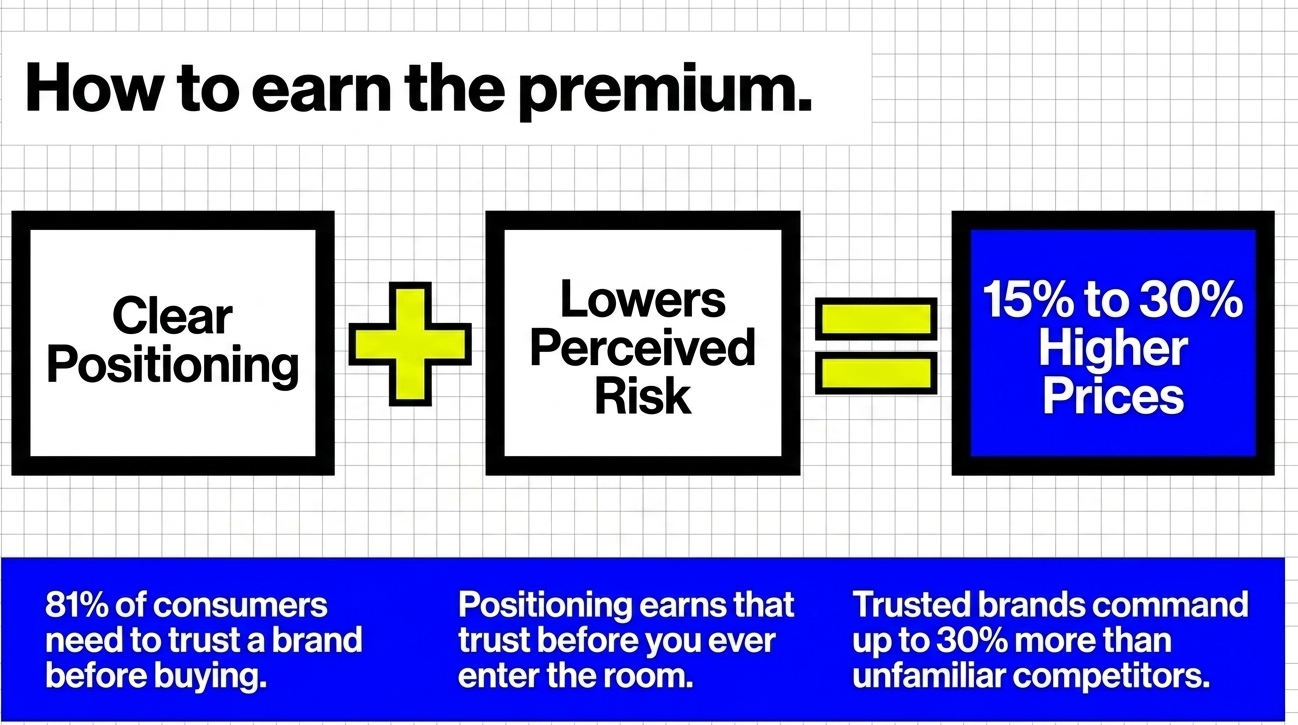
- Trusted brands command 15 to 30% higher prices than unfamiliar competitors in the same category. Weak brand strategy is a direct pricing ceiling.
- 71% of businesses report that inconsistent brand presentation creates customer confusion, and confused buyers do not convert.
You have a logo. You may have a color guide and some nice fonts. You probably paid someone real money to build all of it. And if you are honest, none of it has ever closed a deal.
That is not a design problem. That is a strategy problem. Most businesses treat brand identity as the finish line when it is really the last ten yards of a much longer race. The race itself is called brand strategy, and the majority of businesses skipped it entirely.
The marketing industry has done a thorough job of conflating these two things. Agencies pitch logos, color schemes, and “visual identity systems” as though the visual is the brand. It is not. A logo is a recognition trigger. It only works once the underlying strategy has earned something worth recognizing.
What Brand Strategy Actually Covers Beyond Your Logo and Color Palette
Brand strategy is the documented answer to four questions most businesses have never formally answered: who you serve, what problem you solve for them, why they should believe you over the alternative, and what it feels like to work with you at every touchpoint. If those four questions do not have clear, consistent answers, then the logo is just decoration.
This distinction matters because buyers do not buy logos. They buy certainty. They want to know the company understands their problem, has solved it before, and is worth trusting with real money. The visual signals competence from a distance. The strategy is what makes someone stop and actually consider you.
57% of small businesses will pay up to $500 for a logo. The average branding project executed by a small firm runs between $5,000 and $20,000. Both numbers are spent before any real positioning work happens, which explains why so many businesses end up with polished visuals wrapped around unclear messaging. The assets look finished. The brand is not.
How Weak Brand Positioning Caps Pricing Before a Conversation Starts
Trusted brands charge 15 to 30% more than comparable competitors in most categories. That is not a marketing stat intended to motivate you. That is what happens when buyers perceive a brand as lower risk. When positioning is vague, the buyer fills in the blanks with skepticism, and then they ask for a discount to compensate.
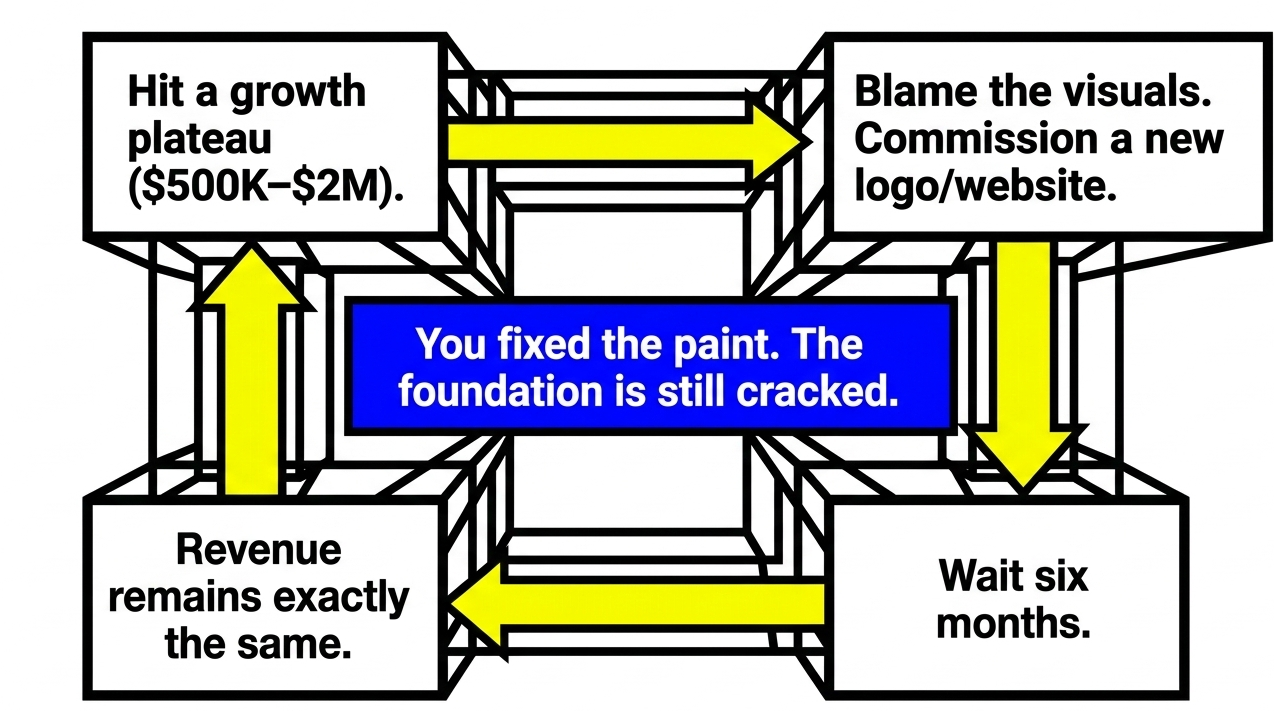
Brand positioning is the decision about where you sit in the market relative to alternatives and how you communicate that. It is not a tagline. It is a strategic answer to the question every buyer is silently asking: why you, not them? If your answer sounds like everyone else’s answer, you compete on price. That is the most reliable way to shrink margins while working harder than anyone in the room.
The businesses that charge at the top of their category almost never win on features alone. They win because the buyer perceives the purchase as lower risk. That perception is the direct output of clear, consistent brand positioning. 81% of consumers say they need to trust a brand before they will buy from it. Positioning is how you earn that trust before you are ever in the room.
Brand Consistency and the Revenue It Quietly Leaks
Companies with consistent brand presentation across channels see revenue increases of up to 23%. That number sounds abstract until you look at what inconsistency actually looks like: a website that feels completely different from the Instagram profile, proposals that use different language than the homepage, a sales pitch that contradicts the positioning on every page of the content archive.
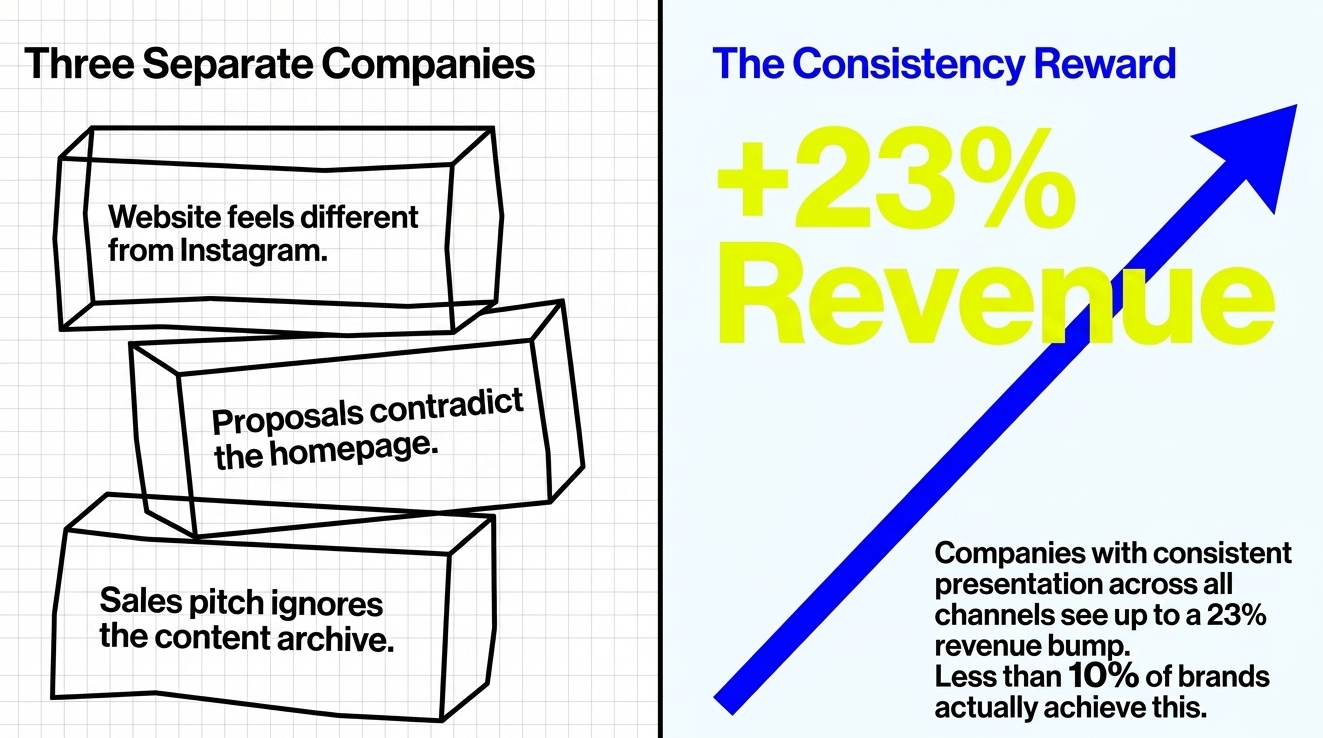
Only 25% of companies have formal brand guidelines and actively enforce them. Less than 10% of brands maintain high-level consistency across all marketing channels. This means that for most businesses, the experience of discovering them, researching them, and speaking with them feels like three separate companies. That friction does not stop buyers from moving forward in a forgiving market. In a competitive one, it does.
Inconsistency is expensive not because it looks bad but because it signals uncertainty. When a brand cannot decide what it is, buyers reasonably conclude the company cannot decide what it is either. 71% of businesses confirm that inconsistent brand presentation directly causes customer confusion. Confused buyers delay decisions. Delayed decisions become lost deals.
The Rebrand Trap That Keeps Mid-Size Businesses Stuck
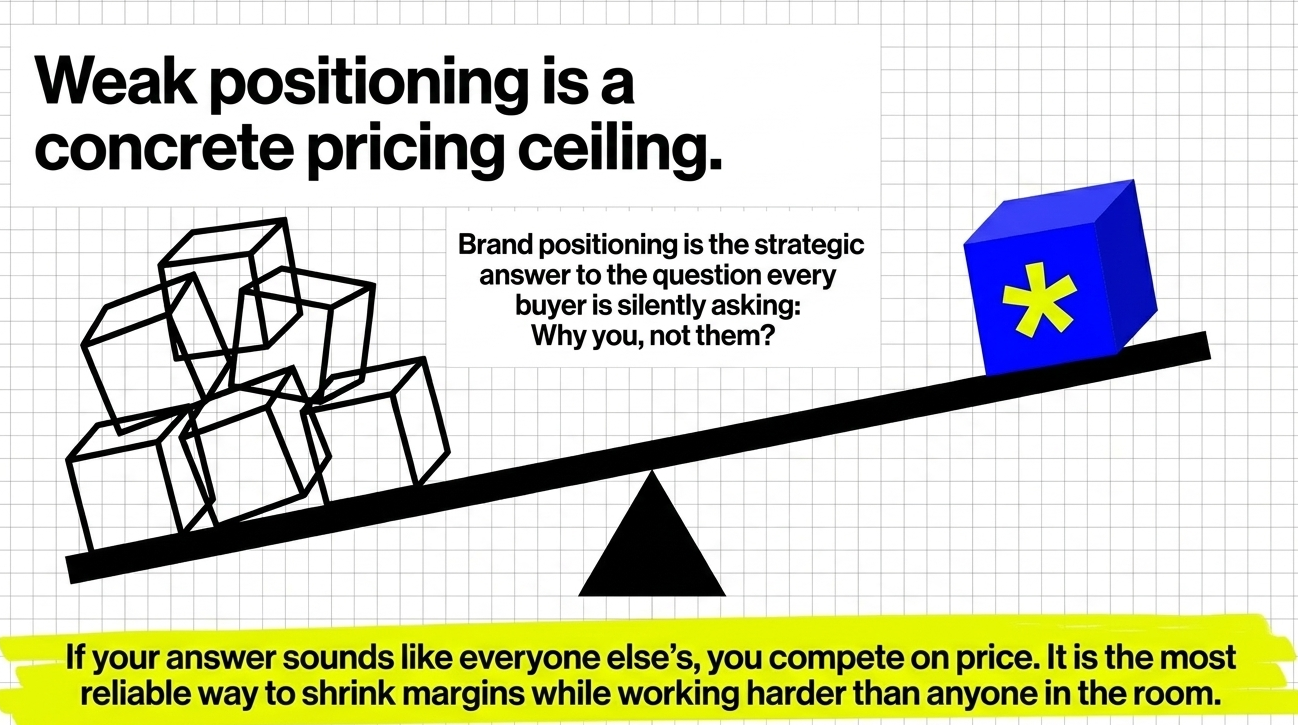
There is a recognizable pattern in businesses between $500K and $2M. They hit a growth plateau, look around for the cause, and land on something visible. The brand. A new logo gets commissioned, sometimes a new name, occasionally a whole site redesign. Six months later, revenue is approximately the same.
This happens because the rebrand addressed the symptom, not the problem. The actual issue is almost always positioning: who the business claims to serve, how clearly it communicates its offer, and whether buyers can immediately tell why to choose this company over a competitor with a similarly attractive website. None of those things get fixed by updating the wordmark.
Rebranding without repositioning is interior design in a building with a bad foundation. The rooms look different. The structural problem is exactly where it was.
What a Revenue-Connected Brand Strategy Actually Looks Like
A brand strategy built around business outcomes starts with the offer and the buyer, not the visuals. It answers what the company does in plain language, identifies the specific buyer who has the problem it solves, articulates why that buyer should believe the company can solve it, and defines the exact language that makes the pitch land. The visual expression of that strategy gets built afterward.
The practical output is not a mood board. It is a positioning document that informs how the website is written, how proposals are framed, how sales conversations open, and how the company shows up on every platform it touches. Consistency at that level is what turns brand recognition into revenue. It is what allows price increases to feel reasonable instead of aggressive.
Big Click Energy approaches brand strategy as infrastructure, not aesthetics. The deliverable that matters is a business that buyers can quickly understand, easily trust, and confidently choose. The logo follows. It does not lead.
FAQ
What is brand strategy and why does it matter for a service business? Brand strategy is the documented framework that defines who your business serves, what you offer, why buyers should trust you over competitors, and how that story gets told consistently. For service businesses, it matters because services are harder to evaluate than products. Buyers rely heavily on perceived credibility and clear positioning to make the decision to start a conversation. Without a defined brand strategy, the business often competes on price by default.
How does brand positioning actually affect my revenue? Brand positioning affects pricing tolerance, conversion rate, and sales cycle length. When your positioning is clear and differentiated, buyers understand your value without needing to be convinced. That clarity reduces friction at every stage of the buying process. Trusted, well-positioned brands consistently command 15 to 30% higher prices than vague competitors, not because the product or service is dramatically better but because the perceived risk of buying from them is lower.
Can a new logo help improve my brand? A new logo can improve brand recognition once the underlying strategy is clear and consistent. On its own, it changes how the business looks but not how it is understood. If positioning is weak or messaging is inconsistent, a new logo is a visual update applied to the same underlying problem. Fix the strategy first. The visual expression should follow and reflect it.
What does brand consistency actually mean in practice? Brand consistency means the experience of discovering your business, visiting your website, reading your proposals, and speaking with your team all feel like the same company with the same clear message. It is not just using the same fonts and colors. It is using the same language to describe what you do, who you serve, and what makes you different across every channel and touchpoint. Less than 10% of brands achieve this, which is why most businesses feel scattered to buyers who encounter them across multiple platforms.
How long does it take for brand strategy to impact revenue? For positioning changes that affect sales conversations and proposal quality, the feedback is often immediate because the changes show up in how buyers respond during those conversations. For broader brand strategy shifts that need to propagate across a website, content, and paid channels, expect a meaningful signal within one to three months. Businesses that have been operating with unclear positioning for years sometimes underestimate how quickly the clarity starts working once it is actually in place.