
TLDR:
- Google Ads average cost per lead across industries is $70.11. Facebook’s average is $27.66. Cheaper is not the same as better, and treating cost per lead as the primary decision metric is where most paid advertising budgets go sideways.
- Google Ads carry a 4.2% average conversion rate across industries. Facebook leads campaigns average 7.72% on conversions, but the buyer states behind those numbers are fundamentally different.
- Legal, dental, and home services pay $8 to $13 per click on Google, with good reason. That click came from someone who typed a specific problem into a search bar. The equivalent Facebook click came from an interruption.
- Businesses that combine both platforms report an average 67% increase in overall return on ad spend compared to single-platform advertisers. The question is sequencing and allocation, not which one wins.
Every year, businesses collectively spend billions of dollars on paid advertising after a conversation that goes roughly the same way. An agency recommends the channel they run best. The contract gets signed. The campaigns go live. And at no point in that sequence does anyone ask what the buyer was actually doing when they decided to purchase.
The Google Ads vs. Facebook Ads question is not primarily about cost, it is not about which platform has more users, and it is not about where your competitors are spending. It is about one thing: what state of mind the buyer is in when your ad reaches them.
That distinction determines everything else. The budget. The creative. The landing page. The close rate. Get the channel wrong and even a technically sound campaign loses money in ways that are genuinely hard to diagnose.
The Intent Gap That Makes Google Ads and Facebook Ads Different Problems
Someone searching “emergency plumber near me” on a Tuesday night has already made a decision. They need a plumber. They are not browsing. They are not comparison shopping. They are looking for whoever appears credible enough to solve an active problem. Google puts your ad in front of that person at the exact moment their wallet is open.
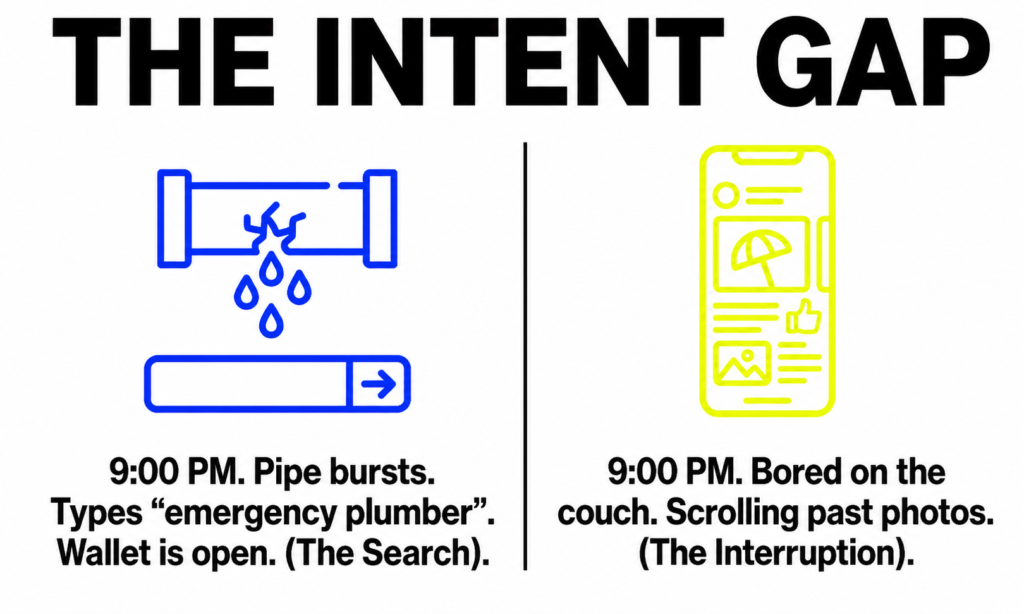
Someone scrolling Facebook on the same Tuesday night is doing something else entirely. They might have a leaky pipe they have been ignoring for a month. They might have thought about getting it fixed and then forgotten. They might respond to the right offer framed the right way. But they are not searching. They are being interrupted.
This is the intent gap, and it is the reason that cheap Facebook clicks regularly become expensive customers while higher-priced Google clicks close faster. Facebook’s average CPC across traffic campaigns is $0.70. Google’s average across all industries is $5.26. At first read that looks like an obvious answer. It is not. The Google click came from someone who typed their problem into a search bar. The Facebook click came from someone who was scrolling past a photo of their cousin’s vacation. When you follow both clicks through to signed contracts, booked appointments, and collected payments, the cheaper channel frequently becomes the more expensive one.
What Google Ads for Local and Service Businesses Actually Costs and Why
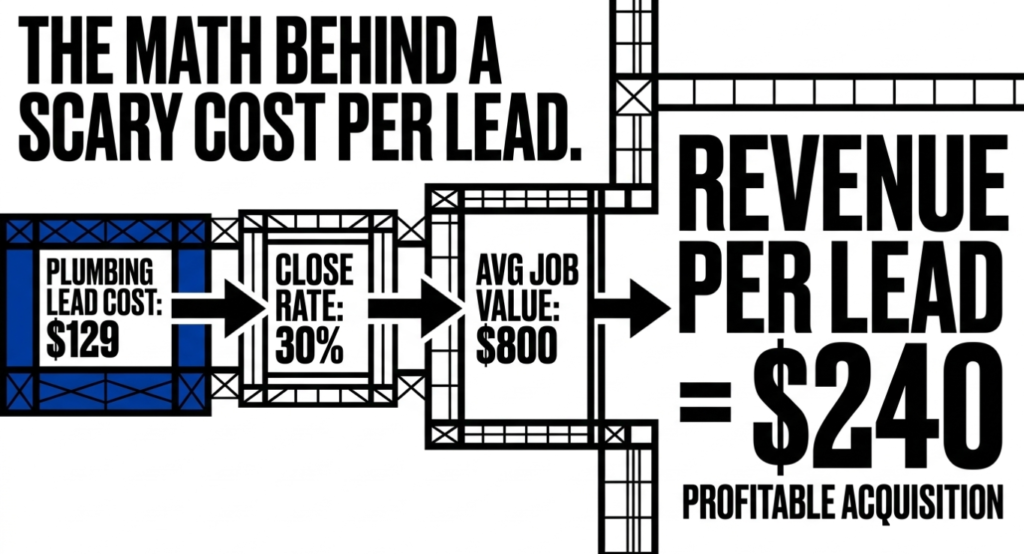
The average cost per lead on Google Ads is $70.11 across industries. Legal services average $131.63. Home improvement sits at $90.92. Plumbing averages $129 per lead. HVAC runs $127. Those numbers alarm business owners until they do the math the right way. A plumbing lead that closes at 30% and produces an average job worth $800 generates $240 in revenue per lead at that cost. A $129 lead in that scenario is a profitable acquisition, not an expensive one.
The industries with the highest Google CPCs are also the ones where buyers move with urgency and have limited patience for discovery. Attorneys at $8.58 per click, dentists at $7.85, electricians at $12.18, painters at $13.74 per click. These are categories where the buyer already knows they have a problem, they already know they need a professional, and they are choosing right now between whoever appears in the search results. Visibility at that moment is the product. The CPC is the price of it.
Google Ads underperforms when businesses use it for categories where buyers do not yet know they have a problem, where the decision is driven by inspiration rather than urgency, or where the average transaction value is too low to justify the cost per click in competitive markets. A restaurant trying to drive $15 dinner reservations through Google search in a major market is working against the math. An emergency locksmith is working with it.
What Facebook Ads Are Actually For and Where the $0.70 Click Goes Wrong
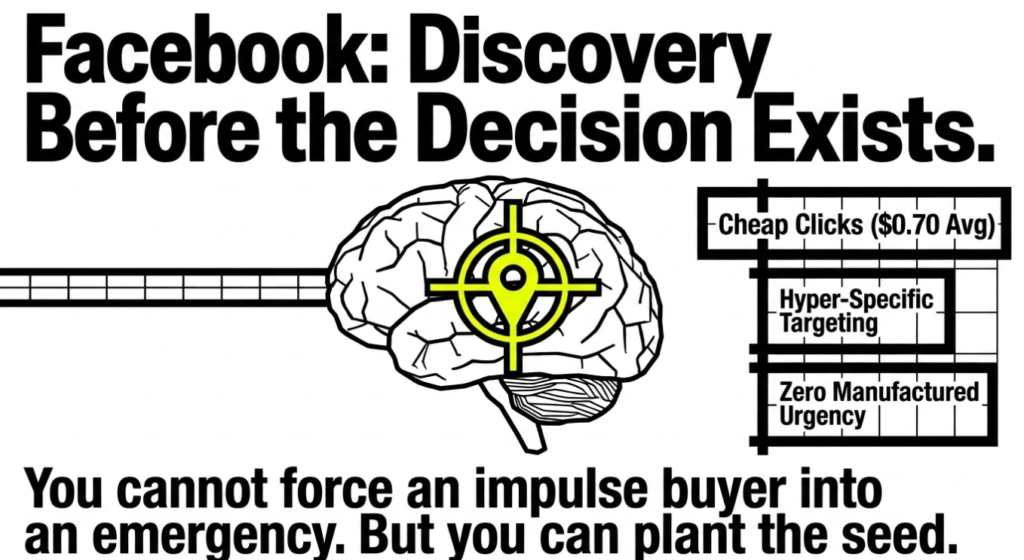
Facebook’s power is not discovery at the moment of decision. It is discovery before the decision exists. The platform knows an extraordinary amount about its users and can place an offer in front of a highly specific audience with real precision. What it cannot manufacture is urgency. A buyer who was not thinking about buying remains someone who was not thinking about buying, regardless of how well the ad performs.
This is not a flaw. It is a feature, used correctly. A gym promotion reaching people who have thought about getting fit but never followed through is exactly what Facebook is built for. A home services company building brand recognition before a homeowner’s next project needs attention is a valid use. A B2C brand launching a new product to a highly targeted demographic that does not know it exists yet has no better tool. Facebook’s targeting capabilities are genuinely sophisticated. Demographics, interests, behaviors, purchase history, lookalike audiences built from your best customers. The platform can find people who look like your buyers at a scale that no other channel matches.
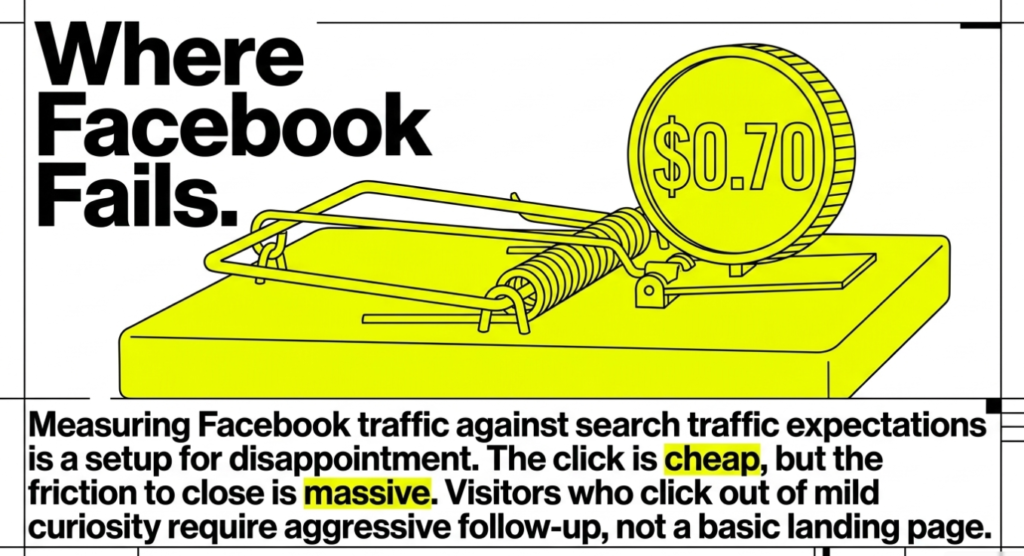
The failure mode is measuring Facebook traffic against the same conversion expectations as search traffic. A visitor who arrived because they were actively searching for your service is categorically different from someone who saw your ad mid-scroll and clicked out of mild curiosity. Facebook visitors typically need more touchpoints before they convert. Landing pages that do not account for the different entry point, with different levels of awareness-building, tend to disappoint on both platforms. When a Facebook campaign is called ineffective, the diagnosis usually points at the landing page, the offer structure, or the conversion expectations, not the targeting.
How the Platform Decision Actually Breaks Down by Business Type
The question is not “which platform is better.” The question is “where is my buyer in the decision process, and which platform finds them there.”
For businesses in categories where buyers search actively when they need the service, trades, legal, dental, urgent care, home improvement, financial services, Google Ads earns its cost structure. The buyer’s intent does the heavy lifting. A well-managed search campaign in these categories finds buyers at the bottom of the funnel and pays for it honestly.
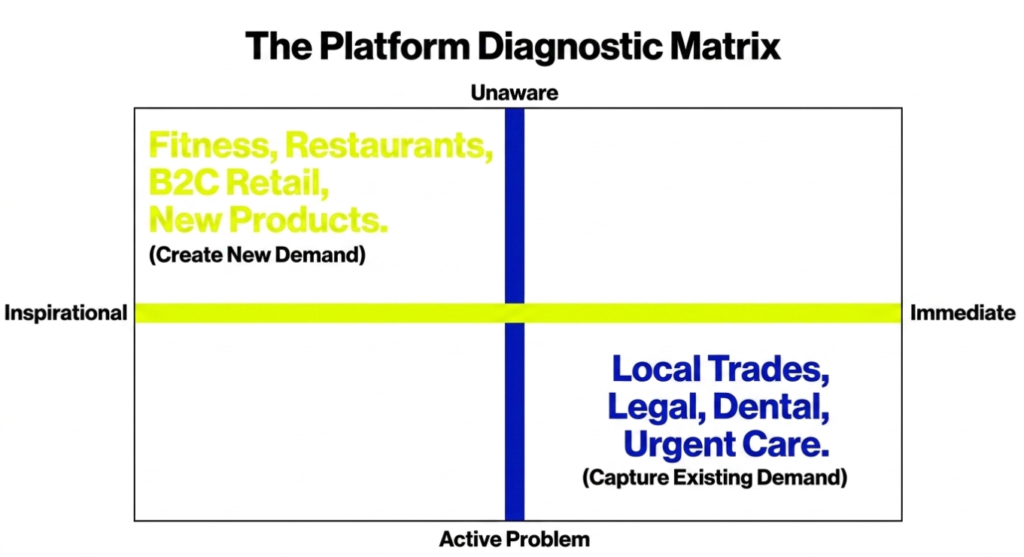
For businesses trying to build awareness before need arises, introduce a new offer into an existing market, or generate volume in categories with broad appeal and visual storytelling potential, Facebook earns its lower cost per click. A consumer product with mass appeal, a fitness or lifestyle brand, a restaurant chain, a retail business running promotions, these categories match Facebook’s demand-creation model.
Retargeting sits in a different category entirely. Running Facebook retargeting ads to people who have already visited your website via Google is not a choice between platforms. It is combining them in the way they were designed to work. Google captures the initial search intent. Facebook stays present during the consideration period. The close rate on retargeted visitors is significantly higher because you are now reaching someone who has already demonstrated interest and needs one more reason to act.
Why Most Businesses Get This Decision Wrong
Most agencies lead with the channel they are best at running. A search team will make the case for Google. A social team will make the case for Facebook. Both arguments will contain accurate information about the platform. Neither argument will start with what the buyer is actually doing when they make a purchase decision, and that is the only question that matters for channel allocation.
The second mistake is treating cost per lead as the primary decision metric without tracing it to cost per customer. Facebook’s $27.66 average cost per lead looks dramatically better than Google’s $70.11. But if Facebook leads close at a lower rate because they are further from the decision point, and if Google leads close faster and at higher average values because they represent active buyers, the economics flip. The only number that actually matters is cost per acquired customer, and that calculation requires knowing what happens after the form fill.
Big Click Energy approaches channel selection by starting with the buyer, not the platform. That means understanding where in the decision process your ideal customer is when they find you, what triggers the decision to buy, and which platform puts your offer in front of them at that moment. For businesses that have received the same channel recommendation from three consecutive agencies, that starting point tends to feel noticeably different.
FAQ
Should I use Google Ads or Facebook Ads for a service business? It depends on whether your buyers search for the service when they need it or need to be reminded that the service exists. Home services, legal, dental, and other categories where customers have an active, identifiable problem tend to see strong ROI from Google Ads because search captures existing demand. Categories where buyers need to discover the service, or where the purchase is driven by timing and offer rather than urgent need, often work better with Facebook’s demand-creation model. Many service businesses benefit from using both.
Why does Google Ads cost more per click than Facebook Ads? Google search clicks are more expensive because they come from buyers who are actively searching for a solution. That intent has real value. A legal services business pays $8.58 per click on Google not because Google is expensive, but because that click came from someone who typed “personal injury lawyer near me” into a search bar. The Facebook equivalent costs $0.70 because it came from someone who was interrupted mid-scroll. When you measure cost per acquired customer rather than cost per click, the gap between the platforms often narrows considerably.
What is the average cost per lead on Google Ads versus Facebook Ads? Google Ads averaged $70.11 per lead across industries in 2025. Facebook averaged $27.66 for lead campaigns. Both numbers vary significantly by industry and campaign quality. Google’s highest CPL categories include legal services at $131.63 and home improvement at $90.92. Facebook costs are generally more consistent across industries but have risen year over year as advertiser competition increases. In both cases, cost per lead only tells part of the story. Close rate and average customer value determine whether those leads are actually profitable.
Can I run Google Ads and Facebook Ads at the same time? Yes, and for most businesses this combination outperforms either platform alone. Businesses using both platforms report an average 67% higher overall return on ad spend compared to single-platform advertisers. A common approach is using Google to capture active search intent and Facebook retargeting to stay in front of visitors who clicked but did not convert. The key is not treating the two platforms as competitors for the same budget but as tools that address different stages of the buyer journey.
What does a good Facebook Ads setup look like for a service business? A strong Facebook Ads setup for a service business typically includes a cold prospecting campaign using a lookalike audience built from your best existing customers, a retargeting campaign aimed at website visitors who did not convert, and creative that is specific enough to be relevant but not so narrow that the audience cannot scale. Measuring Facebook leads against the same close rate expectations as Google leads is a setup for disappointment. Facebook leads are generally earlier in the decision process, which means the follow-up sequence and sales process matter more, not less.