
TLDR
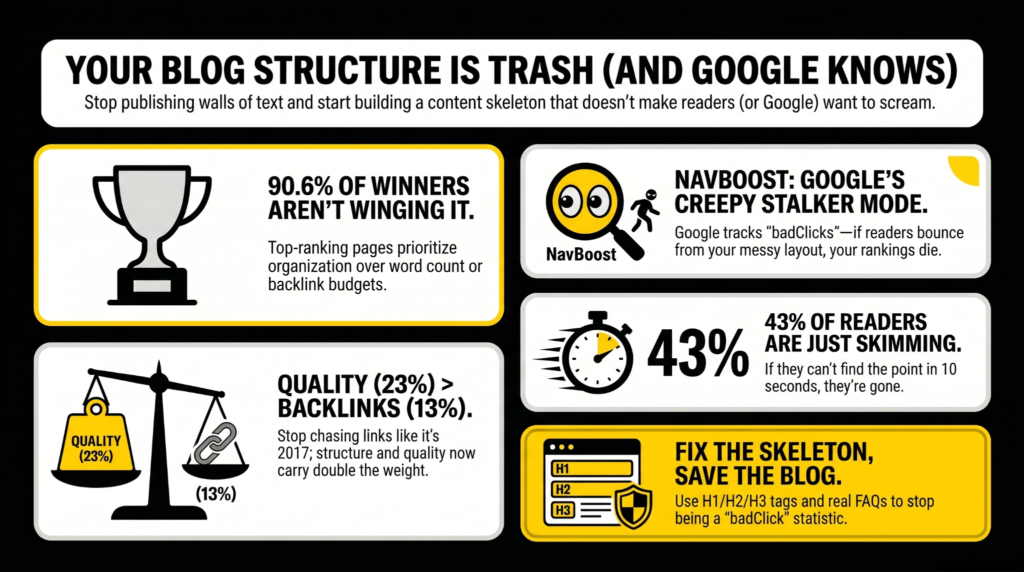
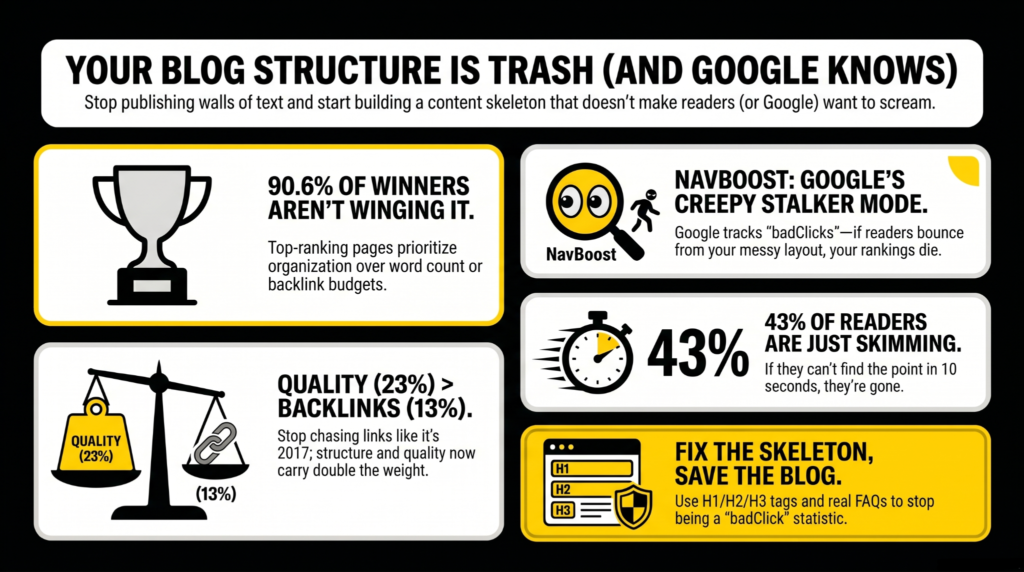
- 90.6% of top-ranking pages are structured. Yours probably isn’t.
- Google has been tracking your bounce rate this whole time. Surprise.
- Content quality outweighs backlinks. Stop buying links like it’s 2017.
- 43% of readers skim. No headings means they’re already gone.
- A FAQ that exists just to exist ranks exactly like it was written.
90.6% of pages ranking in Google’s top 10 have one thing in common. Not the longest word count. Not the most backlinks. Not whoever spent the most money on ads. Just structure. Someone, at some point, thought about how the page was organized before they started typing. That is the whole secret. That is your blog structure problem in one statistic. Sit with that for a second.
That number is from Semrush’s 2024 Ranking Factors Study, by the way. Not a vibe. Not a guess. Published data, sitting there, waiting for someone to care about it.
You have been publishing content without caring about it. We can tell.
We could get so technical about blog structure your head would hurt. That is kind of our thing at Big Click Energy. We analyze, we research, we go deep. What this blog does instead is give you the version that actually makes sense, so you can start making smarter decisions about your content right now.
Google Blog Ranking Factors
Every year, the SEO research firm First Page Sage publishes updated data on what Google’s algorithm actually weighs. Here is what the 2025 numbers look like:
- Content Quality: 23% (up every year since 2022)
- Niche Expertise: 13%
- Backlinks: 13%
- Searcher Engagement: 12%
Content quality is worth nearly double what backlinks are worth. Let that land. Agencies and marketing teams have spent years, and genuinely impressive budgets, chasing backlinks like they’re still in 2017. Meanwhile, content quality and searcher engagement together account for more than a third of where your page lands in results.
Both of those are structural problems. Not keyword problems. Not “we need more content” problems. Structure. The skeleton of how a page is built and whether a human being can actually navigate it without giving up.
Did we think this through, or did we just keep buying links and hoping?
How Google Tracks Reader Behavior On Your Blog
In 2024, Google accidentally published internal documentation it never meant to release. Search Engine Land reported on it. Inside that document was a system called NavBoost.
NavBoost tracks what readers do after they land on a page. Google gave their behavioral categories blunt names: “goodClicks,” “badClicks,” and “lastLongestClicks.” Good clicks are readers who stay. Bad clicks are readers who leave fast and go back to searching. LastLongestClicks are readers who scroll, pause, and genuinely engage.
Google had spent years telling the public that click behavior was not a meaningful ranking signal. Their own internal system was tracking every fast exit and using it to quietly push pages down in results. Make of that what you will.
The connection to blog structure is direct. A reader who lands on a page, sees a wall of unbroken text with no clear sections or headings, and leaves in fifteen seconds? That is a badClick logged against your page. A reader who works through your content section by section? That is a lastLongestClicks. The difference between those two outcomes is how you structured the page.
If readers are bouncing off your pages, there is a structural reason for it. We can find it. Email us at sean@big-click-energy.com
Why Blog Heading Structure Affects Your Rankings
Nielsen Norman Group found that approximately 43% of readers skim content rather than read it word for word. That means before a reader has processed a single full paragraph, nearly half of them have already decided whether to stay or leave based on the visual layout alone.
Headings do two jobs. They tell Google’s crawlers how your content is organized. And they tell skimming readers whether your page is worth their time. When you skip proper heading structure, H1 for your main topic, H2 for major sections, H3 for supporting points, you are losing both audiences at once.
Internal links work the same way. When your blog posts connect to related content across your site, Google starts to see you as an authority on a topic. First Page Sage calls this Niche Expertise, and it accounts for 13% of ranking weight. A blog post that connects to nothing and exists in isolation gets evaluated in exactly that context.
FAQ Section Structure You Need To Implement
Did we write these questions for readers or for ourselves? Because it shows.
Google pulls structured content into featured snippets and AI-generated overviews. A FAQ section built around real questions that real people actually type into search is one of the best structural tools available for earning that placement.
Most FAQ sections are written to technically exist. They tend to perform at exactly that level.
The questions need to match what someone would genuinely search for, not what sounds polished on a page. The answers need to actually answer the question, not pivot into a sales pitch. When the structure matches the intent behind a search, readers stay. When it does not, they leave fast, and those exits accumulate into ranking signals that quietly work against the page over time.
We Could Go Deeper. Much Deeper.
There are algorithm weightings, crawl budget models, internal link equity structures, and behavioral signal thresholds that go several layers past what is in this post. We live in that data. This is what we do at Big Click Energy. We analyze your content strategy, research what your market is actually searching for, and build the structure that turns your blog from a publishing exercise into a traffic asset. When you are ready to see what that looks like for your business, the assessment is free at big-click-energy.com.
Blog Post Structure Best Practices
You do not need to become an SEO expert. You need to stop treating structure like a formatting afterthought.
Use real headings in a logical order. Write intro paragraphs that tell the reader exactly where the article is going. Build FAQ sections around actual search queries. Link your posts to related content on your site. Make your pages easy for a skimmer to navigate in ten seconds.
None of that requires a technical background. It requires deciding that structure matters before you start writing, not after.
The 90.6% stat at the top of this article is not a marketing number. It is what the data consistently shows. The pages that rank are the ones where someone thought about this. The pages that do not rank are the ones where someone figured the content would carry itself.
It rarely does.
Not sure if your content is built to rank? We audit this stuff every day. Email us at sean@big-click-energy.com
Frequently Asked Questions
What does blog structure actually mean? It is the full organizational framework of a page: the heading hierarchy, the logical order of sections, internal links to related content, and elements like FAQ sections. Think of it as the skeleton that tells both readers and search engines how the page is built and what it covers.
Does Google penalize blogs with weak structure? Not with a formal penalty. What happens instead is behavioral. Weak structure leads to fast exits. Google’s NavBoost system logs those exits as negative signals and progressively deprioritizes the page in results. No penalty letter, same outcome.
How does search intent connect to structure? Search intent should drive your structural decisions before anything else. A page answering a specific question is built differently than a page building topical authority on a broad subject. When the structure does not match what the reader came to find, they leave. Fast exits become ranking signals that work against the page over time.
Is word count part of blog structure? Related but different. Pages in Google’s top 10 average around 1,447 words, but length without structure is just a long page that nobody finishes. Word count without hierarchy tends to produce exactly the kind of engagement signals that do not help rankings.
Do FAQ sections actually improve rankings? When the questions are written around genuine search intent, yes. A well-built FAQ is among the structural elements most likely to appear in featured snippets and AI-generated overviews. A FAQ written to technically exist earns the kind of visibility that reflects that level of effort.