
TLDR:
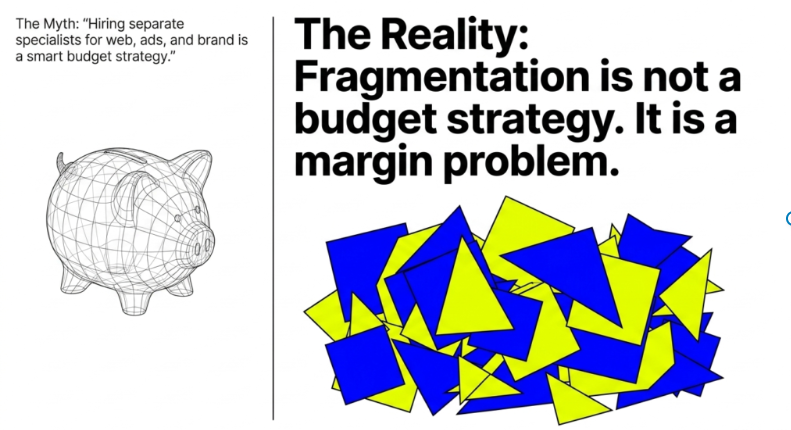
- Integrated marketing campaigns deliver up to 30% higher ROI compared to siloed approaches. Fragmentation is not a budget strategy. It is a margin problem.
- 67% of B2B buyers list inconsistent messaging as a top reason for vendor dissatisfaction. When your web vendor, ad agency, and brand studio are not aligned, buyers feel it before you do.
- Running SEO, paid ads, and social media management separately through independent vendors can total $36,000 to $150,000 per year, often with zero coordination between them.
- 74% of marketing teams report that fragmented tools and data across disconnected vendors make it nearly impossible to get an accurate view of campaign performance.
Three vendors. Three different contacts. Three separate invoices. Three sets of priorities that have nothing to do with each other. And somewhere in the middle of all of it, a business that cannot figure out why its marketing spend keeps growing while the results stay flat.
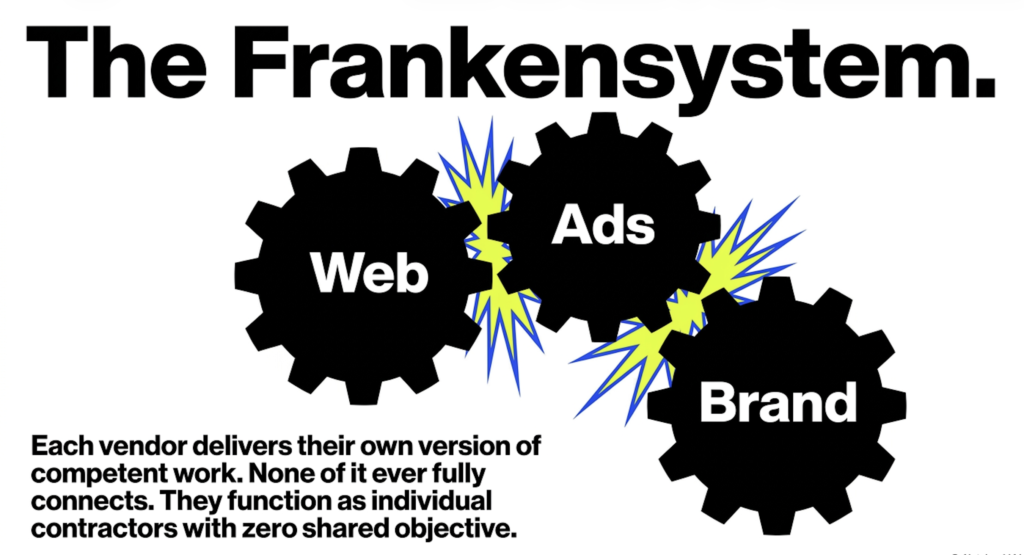
This is not a fringe situation. It is the default setup for most businesses in the $500K to $2M range. A website gets built by one company. Ads get handed to another. The brand guidelines were made by a freelancer two years ago and nobody has looked at them since. Each vendor delivers their own version of competent work, and none of it ever fully connects.
The coordination cost is invisible on any single invoice. That is the problem. You are paying for it every month in wasted spend, misaligned messaging, and a marketing system that does not function as one.
What Fragmented Marketing Vendors Actually Cost Beyond Their Retainers
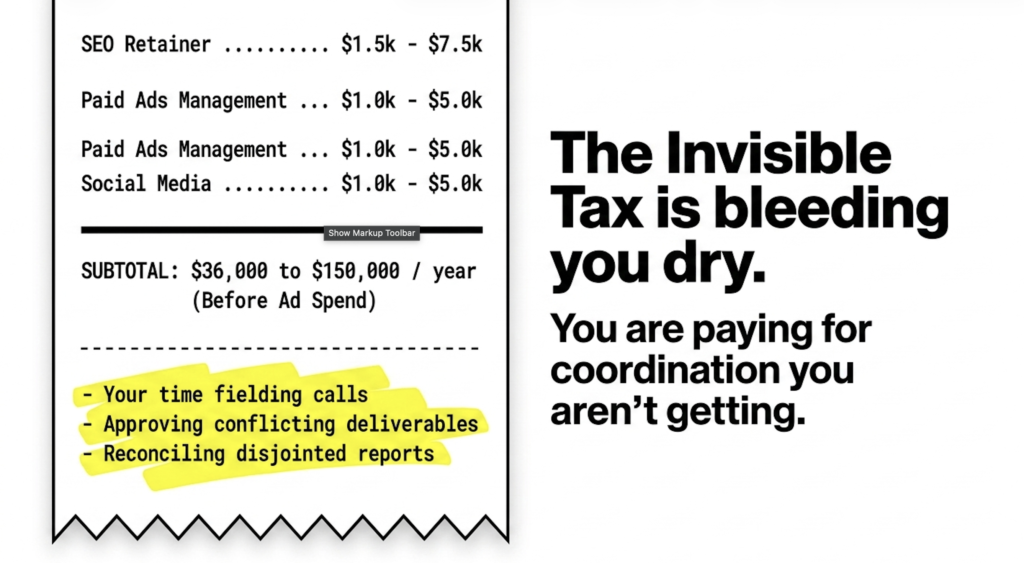
The math on multi-vendor marketing rarely gets done correctly because the costs are spread across too many line items to feel like one number. But when you add them up, the picture is uncomfortable. SEO management alone runs $1,500 to $7,500 monthly. Paid ads management at a specialized shop adds another $1,000 to $5,000. Social media management on top of that is $1,000 to $5,000 more. Put three mid-range specialists together and you are looking at $40,000 to $100,000 per year before any ad spend.
That figure does not include the time cost of managing those relationships. Someone in your business is fielding calls from three agencies, approving three sets of deliverables, reconciling three different reports that use different metrics, and trying to make sure nobody is running contradictory campaigns. That coordination work is real labor, and for most small businesses it lands on the owner.
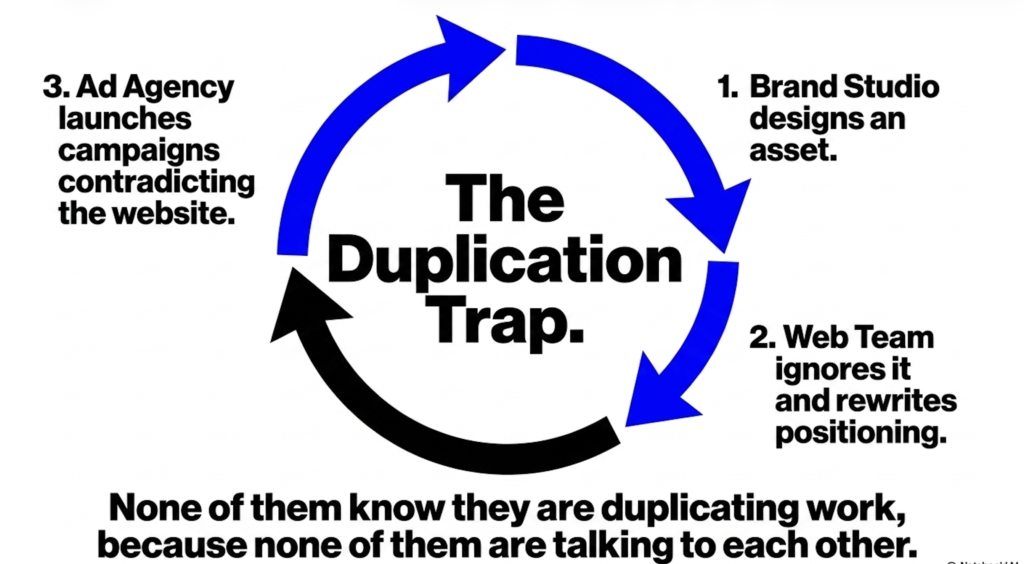
The second hidden cost is duplication. When three vendors are building creative separately, they often reproduce work that already exists elsewhere in the business. One agency rebuilds brand assets the designer already made. Another rewrites positioning copy the web team already finalized. A third launches ads using messaging that contradicts the website. None of them know, because none of them are talking to each other.
How Inconsistent Brand Messaging Across Vendors Leaks Revenue
A buyer rarely evaluates a business on a single touchpoint. They see an ad, visit the website, check the social profile, and read a few reviews. If those experiences feel like they came from three different companies, the buyer’s brain files it as uncertainty, and uncertainty slows or stops purchase decisions.
67% of B2B buyers cite inconsistent messaging as a top reason for vendor dissatisfaction. That is not a statistic about internal teams failing to coordinate. It is a direct signal from buyers that the fragmented experience created by disconnected vendors shows up on the receiving end. Customers do not see your vendor roster. They see one brand, and they expect it to behave like one.
When your ad agency writes one value proposition, your web vendor built the homepage around a different one, and your brand studio positioned you in a third direction, the buyer is doing the work of figuring out what you actually do. Most of them will not bother. Integrated campaigns deliver up to 30% higher ROI compared to siloed approaches precisely because consistency compounds. Every touchpoint that reinforces the same message builds on the last one. Every touchpoint that contradicts it cancels it out.
What an Integrated Marketing Strategy Actually Fixes
An integrated marketing strategy is not just a way to keep everyone in the same chat thread. It is a structural decision about how information flows, how channels support each other, and how performance data gets read as one coherent system instead of three separate ones.
When your website, ads, and brand are built around the same strategy, the feedback from ads informs how the site converts. The positioning baked into the brand brief shapes what the ads say. The website copy reflects the same language the sales team uses on calls. That alignment is how marketing actually compounds, and it is nearly impossible when each vendor is operating from their own brief and optimizing for their own deliverables.
The attribution problem is equally real. 74% of marketing teams report that fragmented data across disconnected vendors makes accurate performance measurement nearly impossible. When your Google Ads account is managed by one company, your website analytics are read by another, and your social reporting goes to a third, you have three different stories about what is working. Usually none of them account for how the other channels contributed. So budget decisions get made on incomplete information, and the channels that appear to perform best in isolation get more money, even if they are actually relying on the other channels to do the conversion work.
What the Full-Service Agency Argument Actually Comes Down To
The case for a full-service digital marketing agency is not that big agencies do better work than specialists. Some specialists are extraordinary. The case is that specialists who are not connected to each other do not function as a system. They function as individual contractors with no shared objective.
A full-service partner has one goal for your business. Every channel, every deliverable, every report is oriented toward the same outcome. When the ad spend is underperforming, the same team looks at the landing page. When the website is not converting, the same team examines the traffic source. There is no negotiation between vendors about whose problem it is. It is all one problem, and one team is accountable for solving it.
Big Click Energy operates as that kind of partner. Brand strategy, web design, paid media, and content work together because they are built together. The output is not four separate deliverables. It is one integrated marketing system, measured against one set of revenue goals. For businesses that have spent two years paying three vendors and still cannot tell what is working, that tends to be a meaningful shift.
FAQ
What is a full-service digital marketing agency? A full-service digital marketing agency handles brand strategy, website design, paid advertising, content, and social media under one roof. Rather than coordinating between vendors who optimize independently, a full-service partner aligns all channels around one strategy and holds them accountable to the same business outcomes. The practical difference is that performance data from each channel informs the others, instead of each team reporting separately on their own metrics.
Is it cheaper to use one marketing agency or multiple vendors? Multiple vendors appear cheaper until you account for the full picture. Separate retainers for ads management, SEO, and social media can run $36,000 to $150,000 annually before any ad spend. Add the internal coordination time and duplicated creative production, and the real cost is significantly higher than a single integrated retainer. The more important question is whether the system is producing a return. Fragmented vendors almost never produce one because the channels are not working together.
What does inconsistent brand messaging actually cost a business? Inconsistent messaging creates friction at every point in the buyer journey. When your ad, your website, and your social presence tell different stories, buyers have to do extra work to decide whether to trust you. Most will not. 67% of B2B buyers say inconsistent messaging directly contributes to vendor dissatisfaction, and dissatisfied buyers either delay decisions or go elsewhere. The revenue that disappears because of that friction rarely shows up on any single vendor’s report.
How do I know if my marketing vendors are not working together? The clearest signal is that each vendor’s reporting tells a different story. If your ad agency says performance looks strong but inquiries are flat, if your website shows traffic but no leads, or if your brand looks like a different company across platforms, the system is not integrated. A second signal is that you are personally spending time coordinating between vendors every week. That coordination work should not exist if the strategy is unified.
When does it make sense to use a full-service agency versus specialists? For businesses doing $500K to $2M in revenue, the bandwidth to manage multiple specialist relationships rarely exists. The coordination overhead compounds quickly, and the lack of an integrated strategy tends to cost more than it saves. Specialists can make sense at higher revenue levels where a dedicated internal team can serve as the integrating layer and hold each vendor accountable to a shared plan. Below that, the full-service approach almost always produces better results per dollar spent.