
TLDR:
- Only 5.7% of new pages reach the top 10 within one year of publication. The average page ranking in the top 10 is over two years old.
- Most businesses start seeing measurable organic traffic movement between 3 and 6 months, with meaningful revenue impact typically arriving at 6 to 12 months.
- SEO leads close at a rate of 14.6%, compared to 1.7% for outbound channels. The wait is long but the quality of what comes through is materially different.
- Once organic rankings are established, every dollar invested in SEO has returned roughly $19.90 in value on average, compared to $4.40 for paid ads. The gap widens the longer the strategy runs.
Most agencies give you a vague answer on this. “SEO takes time” is not an answer. It is a dodge. The honest version requires being specific about what happens when, why some businesses see traction faster than others, and where the compounding return actually kicks in. The dishonest version involves showing a chart that goes sharply up with no dates attached and a contract that runs 12 months minimum.
Every business that has ever signed an SEO contract deserves to understand exactly what they are paying for during the part where nothing is happening yet, because that period is real and it lasts longer than most agencies prefer to explain upfront.
The timeline exists because SEO is not a campaign you turn on. It is trust you accumulate, and trust is not something Google awards quickly.
What the Organic Search Timeline Actually Looks Like Month by Month
Months 1 and 2 are almost entirely invisible from a revenue standpoint. Technical issues get fixed. Page structure gets improved. Content gets written or revised. Google crawls the updates. Nothing in your analytics looks different yet, and that is completely normal. The work being done in these months is foundational and its absence later is expensive, but there is no metric that makes it look impressive on a reporting slide.
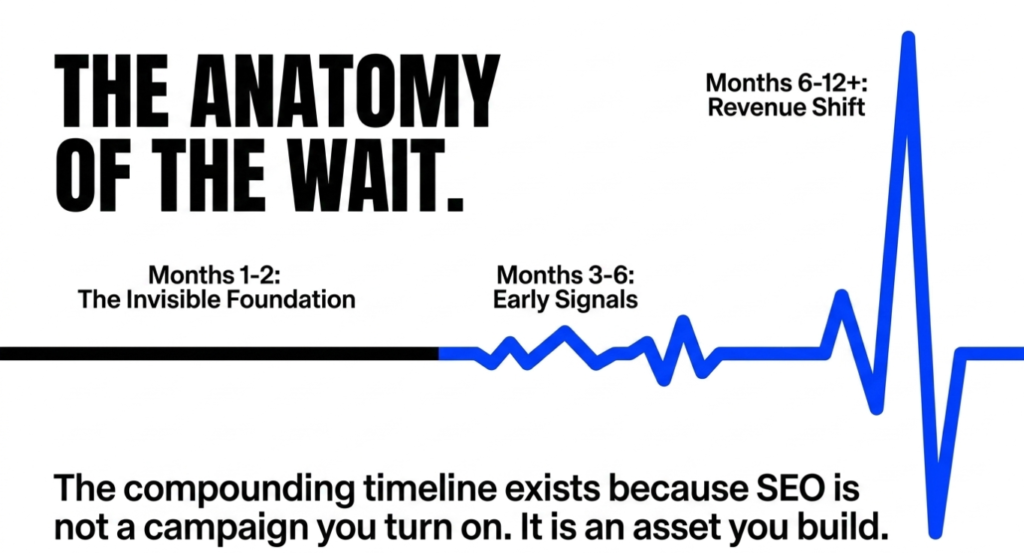
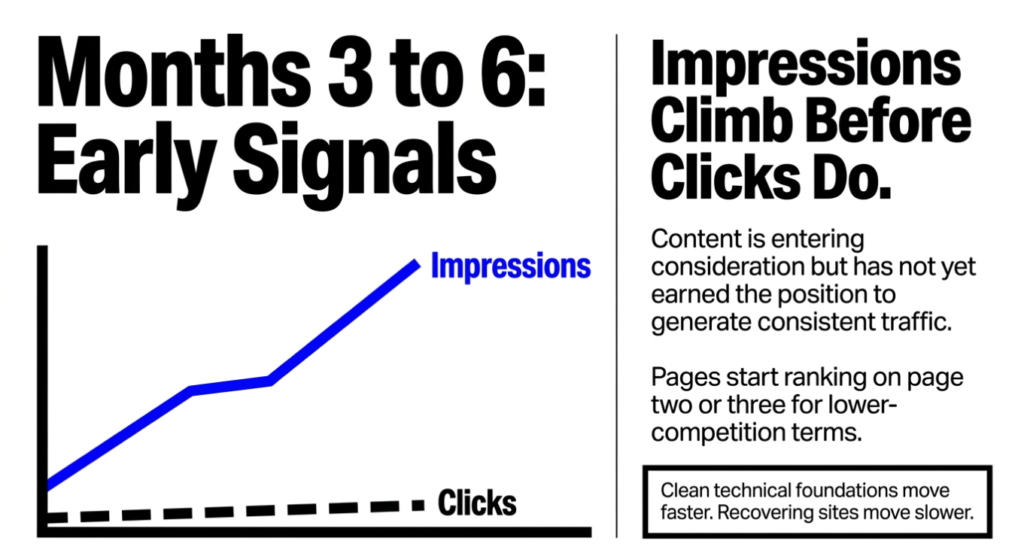
Months 3 through 6 are when early signals start appearing. Impressions in Google Search Console begin climbing before clicks do, which means the content is entering consideration but has not yet earned the position to generate consistent traffic. Some pages start ranking on page two or three for lower-competition terms. Businesses with existing domain authority and a clean technical foundation tend to see this phase move faster. Newer sites or those recovering from technical problems move slower.
Months 6 through 12 are where meaningful revenue movement tends to arrive, assuming the strategy was built around commercial intent and not just traffic. This is when well-optimized pages start cracking the top 10, contact form submissions start ticking up from organic, and the first attribution conversation with your leadership team becomes possible. For competitive industries, even this timeline is optimistic. Legal, finance, insurance, and similar high-competition verticals often need 12 to 24 months before significant page one presence develops.
Why the Top 10 Is Older Than Most New Campaigns Expect
The average page ranking in Google’s top 10 is over two years old. That figure comes from an Ahrefs analysis of 2 million keyword searches, and it tends to alarm business owners who signed up expecting six-month results. The clarification matters: older pages do not rank because they are old. They rank because they have had time to accumulate what Google actually measures: backlinks, topical depth, user engagement signals, and content that has been refined over multiple updates.
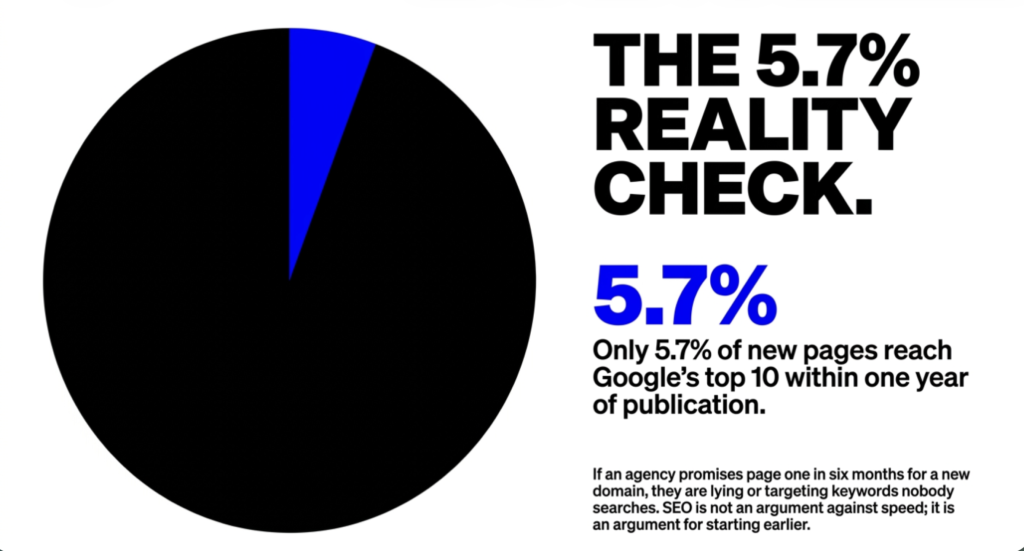
Only 5.7% of new pages reach the top 10 within the first year of publication. That is not an argument against SEO. It is an argument for starting earlier. A page you publish today that does not reach page one for 18 months is still ahead of the page you do not publish until month 19 because you kept waiting to see results from the first campaign.
The businesses that consistently frustrate themselves with SEO are the ones who start a campaign, see minimal movement at month four, and either stop or switch agencies. They restart the clock. The compounding that SEO produces only happens in the businesses willing to let the clock run.
What Local SEO Timelines Look Like Versus National or Competitive Niches
Local SEO is meaningfully different from national or competitive keyword strategies, and the timelines reflect that. A plumbing company in a mid-size market optimizing their Google Business Profile and targeting phrases like “plumber near me” or “emergency plumber [city name]” can see real inquiry lift in 60 to 90 days from technical and local optimization work. The competition at the local level, while real, is not the same as competing against a national brand with thousands of backlinks and a content library built over a decade.
Service businesses in lower-competition local markets see the fastest early returns from SEO. Trades, home services, dental, legal, and medical practices in most non-major markets can realistically tie organic growth to revenue within the first six months when the strategy is focused and the technical foundation is clean. The mistake most of these businesses make is targeting keywords that are too broad, too competitive, or too low in commercial intent. Ranking for “home renovations” is a different problem than ranking for “kitchen remodeling contractors in [city].” The second one converts.
For national campaigns, competitive keywords, or businesses entering a category already dominated by established players, the realistic expectation is 12 to 24 months before organic search becomes a primary lead source. That is not a failure. That is what building a channel looks like versus renting one.
How to Read SEO Progress Before Revenue Shows Up
The hardest part of an honest SEO timeline is explaining what the leading indicators look like, because business owners have been burned before and want to see numbers tied to dollars. Revenue is a lagging indicator of SEO success. The leading indicators are different, and they matter.
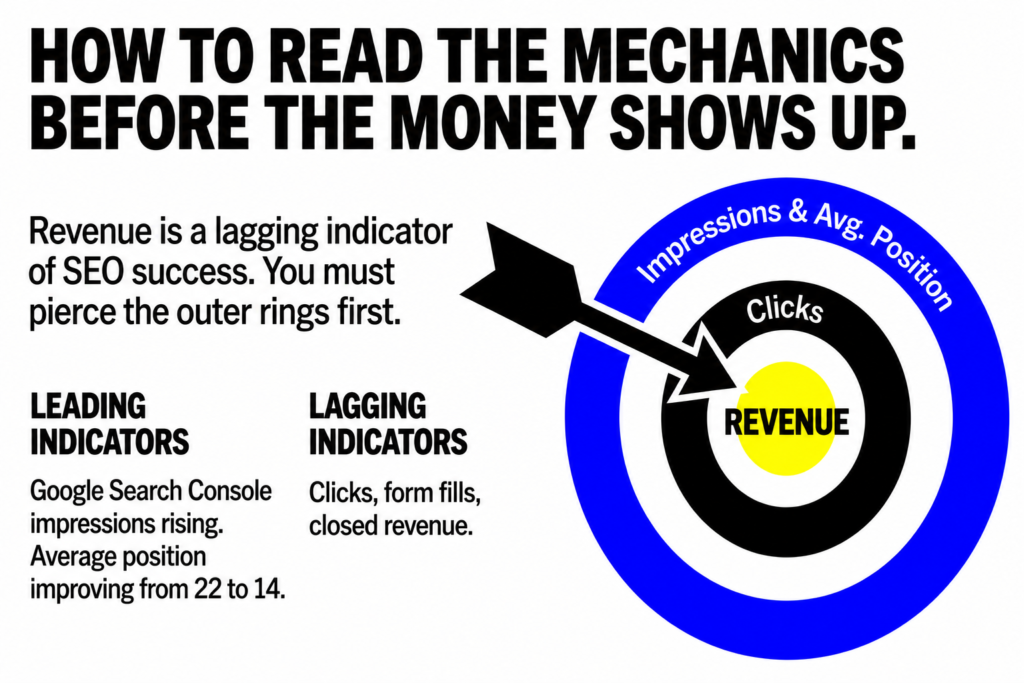
Search Console impressions going up before clicks do means content is entering consideration. Average position improving from 22 to 14 for a target keyword means the page is climbing toward the threshold where click-through rates materially change. At position 10, organic CTR averages around 3%. At position 1, it is closer to 27%. That jump from page two to the top three represents most of the traffic difference, and it usually happens later in the timeline than everything before it.
Any SEO agency that cannot show you movement in impressions and average position during the first 90 days is not doing anything. Clicks and revenue take longer. Rankings and impressions moving in the right direction in the first few months are confirmation that the work is pointed in the right direction. If those numbers are flat at month four, the strategy has a problem.
The Long-Term Math That Makes SEO Worth the Wait
Paid ads deliver traffic the same day the campaign goes live. When the campaign stops, the traffic stops with it. That is a perfectly valid tool for a business that needs leads immediately and has budget to sustain the spend. It is not a scalable asset. The moment you stop paying, you are back to where you started.
SEO builds differently. A page that reaches position one for a valuable keyword keeps generating traffic without additional cost per click. Organic search drives 53% of all web traffic and leads from it close at 14.6%, compared to 1.7% for outbound channels like cold email or direct mail. The average cost per lead from organic search at maturity sits between $14 and $47. The equivalent in Google Ads for the same keyword categories runs $75 to $200 or higher.
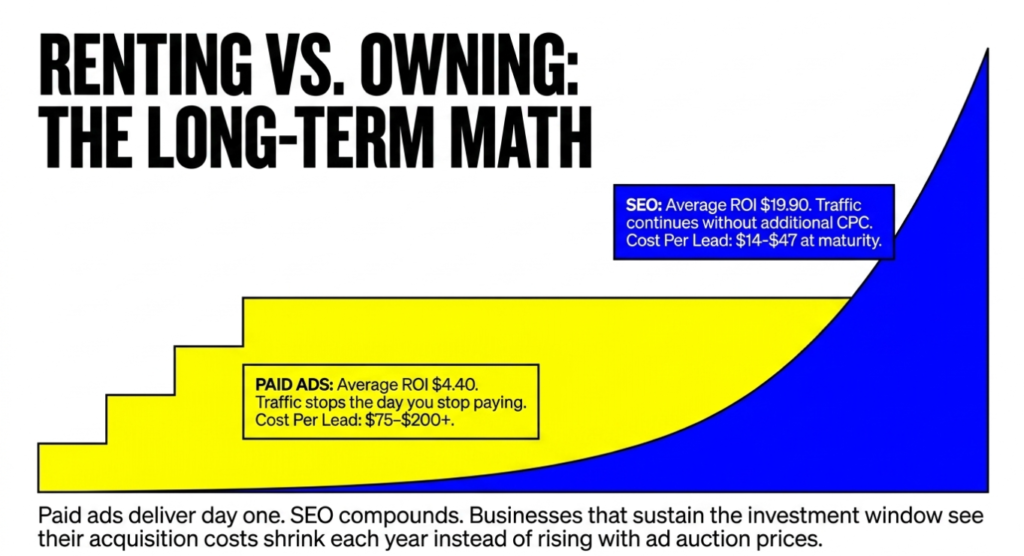
The compounding effect is where the real math becomes interesting. SEO ROI tends to be significantly ahead of paid at 12 months and much farther ahead at 24. The businesses that treat organic search as a long-term asset rather than a quick-win channel are the ones whose marketing costs per acquisition shrink each year instead of rising with ad auction prices. That is the trade: slower start, but a compounding return that paid channels cannot replicate.
FAQ
How long does SEO take to show results for a new website? For a brand new domain with no existing authority, 6 to 12 months is the realistic window before meaningful organic traffic appears. The early months are spent establishing technical health, building indexed content, and earning initial links. Local searches with lower competition can show traction in 90 days. Competitive national keywords typically take longer. Only 5.7% of pages reach the top 10 within their first year, so expectations need to match that reality from the start.
How long does local SEO take? Local SEO timelines are faster than broader campaigns. Businesses in service categories like trades, dental, or legal that optimize their Google Business Profile, build local citations, and publish locally-relevant content often see measurable lead increases within 60 to 90 days. Full competitive local SEO, where rankings stabilize and organic inquiry becomes consistent, typically takes 4 to 6 months when the work is done correctly from month one.
What should SEO progress look like in the first 3 months? Rising impressions in Google Search Console and improving average positions for target keywords are the right leading indicators in the first 90 days. You should not expect significant revenue from organic traffic yet, but you should expect visible movement in crawl coverage, page indexation, and the earliest keyword signals. If impressions and average positions are flat at month three with no explanation, the strategy is not working.
Is SEO better than paid ads for a small business? For long-term customer acquisition, yes. SEO leads close at a meaningfully higher rate than paid traffic, and the cost per lead at maturity is a fraction of comparable paid keyword costs. The trade-off is time. Paid ads generate leads from day one. SEO typically takes 4 to 8 months before it reaches break-even and then compounds from there. Businesses that can sustain the investment window almost always find organic search to be the higher-value channel over a 12 to 24 month horizon.
What kills an SEO timeline and makes it take longer? The most common causes of a delayed organic search timeline are a weak technical foundation that prevents pages from being properly crawled, content written around low-intent or unrealistic keywords, an absence of backlinks, and stopping the campaign before authority accumulates. Switching agencies or strategies every four to six months is the most reliable way to prevent results from ever arriving, because each restart resets the momentum that was building.