
TLDR:
- Brands that justify higher prices through strong positioning grew at twice the rate of peers and added 67% to their brand value over four years. Weak brands compete on price by default, not by choice.
- McKinsey research shows companies that adopt value-based pricing improve return on sales by 5 to 10 percentage points. The shift is not a pricing decision. It is a positioning decision made before the price conversation starts.
- When brands are weak and undifferentiated, price becomes the dominant factor in the buyer’s decision. That is not a market condition. It is a positioning failure.
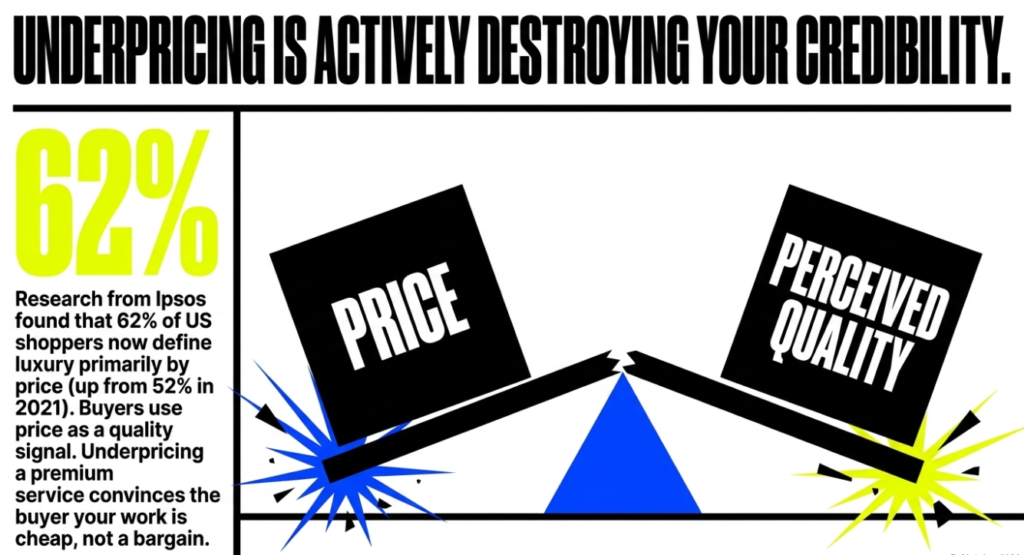
- 62% of US shoppers now define luxury primarily by price, up from 52% in 2021. Buyers are increasingly using price as a quality signal, which means underpricing a well-positioned service actively works against the perception you are trying to create.
When a prospect asks for a discount before the proposal is signed, that is not a negotiation tactic. It is feedback on how the business is positioned. If your offer looks like everyone else’s offer in the same category, price becomes the only meaningful variable left to compare. Buyers are not irrational. They are doing the only rational thing available when they cannot tell the difference between you and the next option on the list.
Most service businesses respond to this problem by working harder on their offer. Better deliverables, faster turnaround, more included. None of that fixes it, because the problem is not the service. The problem is how the service is framed before the buyer ever sees a proposal.
Positioning is the decision you make about where you sit in the buyer’s mind relative to every alternative. Done correctly, it removes price from the center of the conversation. Done incorrectly, or not done at all, price is the only conversation available.
What Brand Positioning Actually Does to Your Pricing Ceiling
Brand positioning is not a tagline exercise. It is the strategic decision about which buyer you serve, which problem you solve better than anyone else, and why that claim is credible. Every element of that definition matters because each one directly determines how much a buyer is willing to pay before the conversation starts.
When positioning is vague, the buyer fills the gap with comparison. They look at your price, look at a competitor’s price, and treat the difference as a reason to negotiate rather than a reflection of different value. When positioning is specific and credible, the comparison set shrinks. A buyer evaluating a firm that specializes in their exact problem has a harder time pointing at a generalist and saying “that one costs less.” The comparison no longer applies in the same way.
McKinsey research shows companies that adopt value-based positioning and pricing improve return on sales by 5 to 10 percentage points. That improvement does not come from raising prices arbitrarily. It comes from aligning what the business charges with what the business can demonstrably prove it is worth, and communicating that clearly before the buyer ever sees a number.
Why Competing on Price Is a Positioning Problem, Not a Market Problem
The most common explanation service businesses give for price pressure is the market. Clients want cheaper options, there is always a cheaper competitor, and buyers do not understand the value of quality work. All of those statements may contain some truth. None of them are the root cause.
Research is direct on this: when brands are weak and undifferentiated, price becomes the dominant factor in buyer decisions. The word “weak” here does not mean the business does bad work. It means the positioning has not communicated what makes the service categorically different in a way the buyer finds meaningful. If you sound like four other agencies in your pitch deck, price is not the buyer being difficult. It is the market giving you accurate feedback.
The businesses that consistently win at premium rates are not competing on price because they have removed themselves from that comparison. They have positioned their offer around a specific outcome for a specific buyer, they have proof that they deliver it, and their messaging reflects that specificity at every touchpoint. When a buyer encounters that, the mental shortcut shifts from “who is cheaper” to “can I afford not to hire them.” That shift is entirely a positioning outcome, not a sales skill.
What Value-Based Pricing Requires Before You Can Charge It
Value-based pricing is the practice of setting prices according to what the buyer believes the outcome is worth rather than what the service costs to deliver or what competitors charge. Most businesses understand the concept and struggle with the implementation, because implementing it requires something that has nothing to do with pricing: a clear, documented articulation of what the buyer gets that no one else gives them.
That articulation has to be specific. “We deliver results” is not positioning. “We have generated an average 4.2x return on ad spend for direct-to-consumer brands in the home goods category over 24 months” is positioning. The second version allows a buyer in that category to calculate the value of hiring you before you ever name a price. When the buyer does that math themselves, the negotiation changes. You are not defending a number. They are asking whether they can access what you deliver.
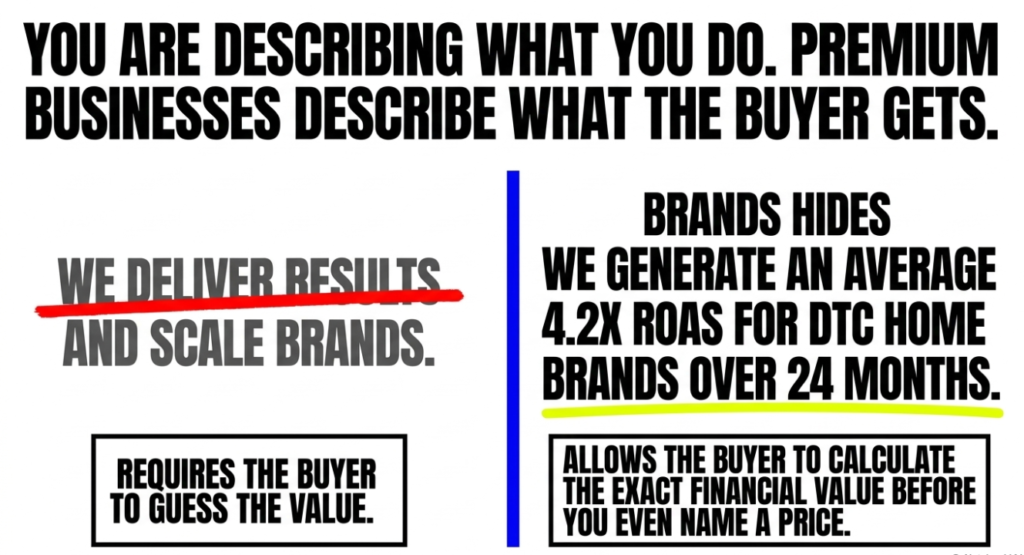
The prerequisite for value-based pricing is proof of value, which requires a track record, case studies, and the willingness to describe outcomes in the buyer’s language rather than the agency’s language. Most service businesses describe what they do. The ones commanding premium prices describe what their clients get.
What Specific Positioning Does to Lead Quality and Sales Efficiency
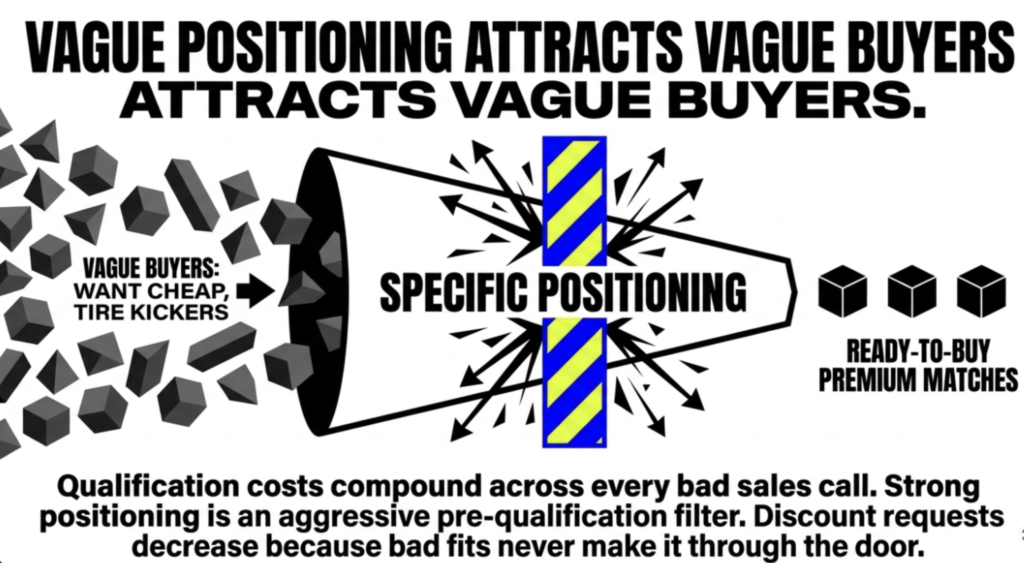
One effect of strong positioning that rarely gets discussed is its impact on who comes through the door. Vague positioning attracts vague buyers, meaning a wide range of people at different budget levels, different maturity levels, and different expectations who all need to be qualified and educated before any real conversation can happen. That qualification cost is real and it compounds across every sales conversation.
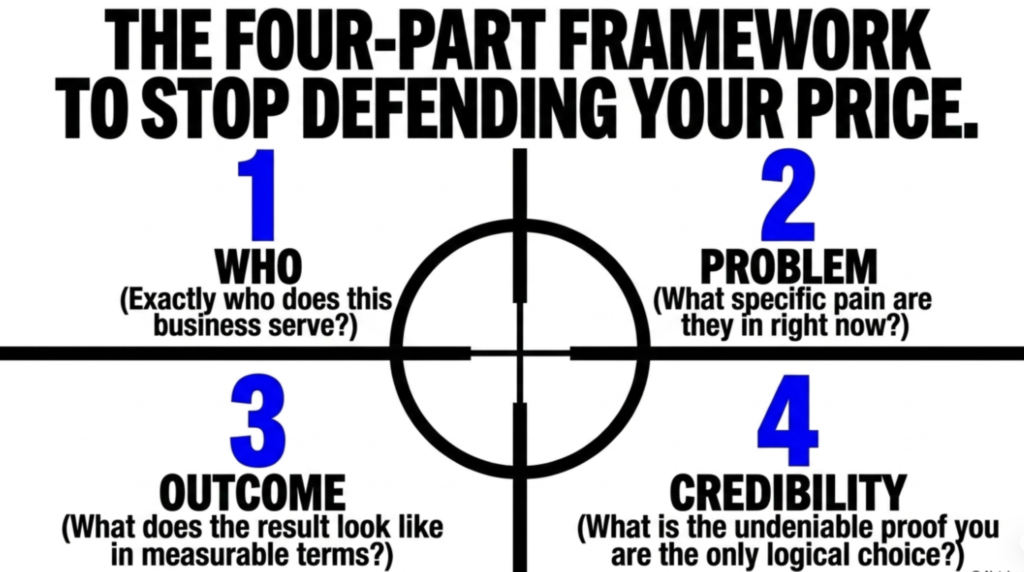
Specific positioning pre-qualifies. A business that clearly communicates who it works with, what problems it solves, and what outcomes it produces will naturally attract buyers who recognize themselves in that description and already believe the value exists before making contact. The sales cycle shortens. Discounting requests decrease. Close rates improve on a smaller but better-matched volume of leads.
Brands capable of justifying higher prices through strong positioning grew at twice the rate of competitors and added 67% to brand value over four years. That acceleration is not purely a pricing effect. It is a compounding effect from the entire commercial system working more efficiently: better-matched buyers, faster decisions, fewer objections, and higher retention from clients who chose the business for reasons other than cost.
How Positioning Breaks Down in Practice and What to Do About It
Most positioning failures follow one of three patterns. The first is positioning to everyone, which produces messaging so broad that it resonates with no one specifically. “We help businesses grow” is an example. Technically true, differentiates nothing, triggers no specific recognition in any specific buyer.
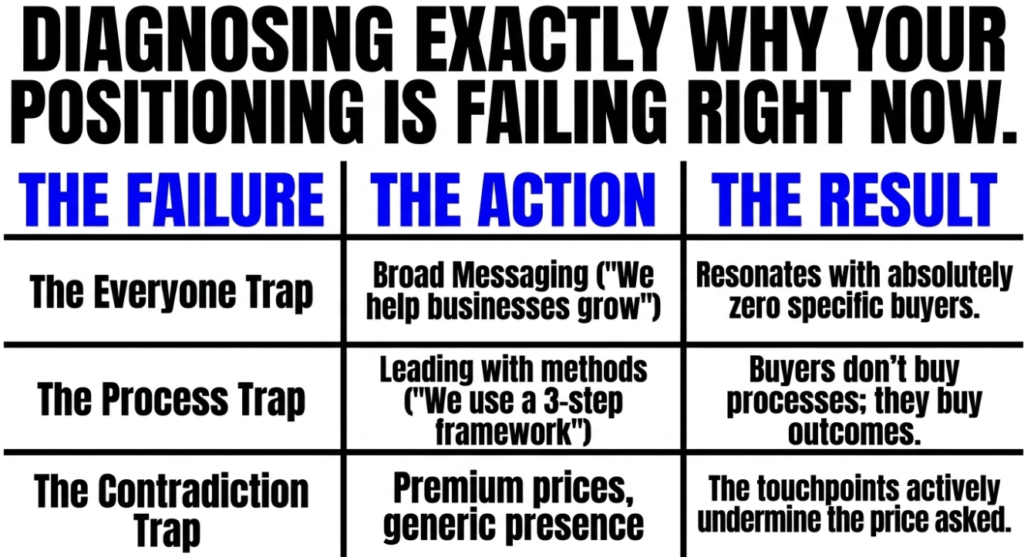
The second is positioning around process rather than outcome. “We use a proven three-step framework” describes a method. It does not describe what the buyer’s situation looks like after working with you. Buyers do not buy processes. They buy outcomes. Positioning that leads with process forces the buyer to do the work of inferring the outcome, and many will not bother.
The third is positioning that contradicts pricing. A business presenting itself as a premium provider with a generic website, inconsistent messaging, and a pitch deck that looks like its competitors will not command premium prices regardless of how the number is framed. Positioning is not just the words on the about page. It is the entire experience of encountering the business, and every touchpoint either reinforces or undermines the price point being asked for. Big Click Energy builds positioning from the revenue goal backward, because the price a business can credibly charge is determined long before a proposal ever gets sent.
FAQ
What is brand positioning and why does it affect pricing? Brand positioning is the strategic decision about where your business sits in a buyer’s mind relative to available alternatives. It defines who you serve, what problem you solve for them, and why you are the credible choice over competitors. Positioning affects pricing because buyers use perceived differentiation to determine willingness to pay. When positioning is vague, price becomes the primary comparison variable. When positioning is specific and credible, buyers are comparing outcomes rather than line items, and the conversation changes accordingly.
What is value-based pricing and how is it different from competitive pricing? Value-based pricing sets prices according to what the buyer believes the outcome is worth, not what competitors charge or what the service costs to deliver. Competitive pricing aligns prices to market averages and is most common in undifferentiated markets. The practical difference is that value-based pricing requires you to articulate and prove a specific outcome in the buyer’s terms, while competitive pricing requires you to track competitor rates and position around them. Companies using value-based pricing consistently produce higher margins. McKinsey research shows the approach improves return on sales by 5 to 10 percentage points for businesses that implement it with clear positioning behind it.
How do I stop competing on price without losing clients? The fix is almost never a pricing change in isolation. It is a positioning change that makes the comparison set smaller. When buyers cannot clearly tell the difference between your offer and a cheaper alternative, they default to price. Narrowing who you claim to serve, which problems you solve, and what outcomes you deliver creates a clearer category where fewer direct comparisons exist. The clients who leave when you raise prices were not evaluating you on positioning. They were evaluating you on price, and those are not the clients a premium positioning strategy is designed to retain.
How does positioning affect buyer perception of quality? Price itself functions as a quality signal. Research from Ipsos found that 62% of US shoppers now define luxury primarily by price, up from 52% in 2021. This means underpricing a genuinely high-quality service can actively work against the perception you are trying to create. Buyers who see a low price relative to alternatives may conclude the service is lower quality rather than a bargain. Strong positioning combined with premium pricing reinforces each other. The price signals the category. The positioning explains why that price is justified. When both are clear and consistent, buyers respond to the combination rather than questioning either element.
What does a strong positioning statement actually include? A strong positioning statement answers four questions: who specifically the business serves, what problem it solves for them, what the outcome looks like in measurable terms, and why the business is the credible choice over alternatives. It is not a tagline. It is an internal strategic document that informs the website, the pitch deck, the sales conversation, and the proposal format. When those four elements are clear and specific, the positioning shows up consistently across every buyer touchpoint. When they are vague or missing, the business defaults to describing what it does rather than what the buyer gets, which puts pricing pressure back at the center of every conversation.