
TLDR:
- Position one organic CTR dropped 32% year over year in 2025. AI Overviews reduce organic CTR for the top result by up to 58% when they appear. A #1 ranking is worth less than it used to be, and it was never a revenue number to begin with.
- 65% of Google searches now end without a click. The traffic your SEO earns is a subset of a shrinking pool, which makes what happens after the click more important than it has ever been.
- Companies that align SEO with conversion rate optimization see 30 to 50% higher conversion rates from organic traffic. Most treat them as separate disciplines that never talk to each other.
- 96.55% of content gets zero organic traffic from Google. A #1 ranking on the wrong keyword is a vanity metric with a report card attached.
The ranking dashboard looks excellent. Position one for the primary keyword. Position two for three supporting terms. Organic sessions are climbing. The agency report is full of green arrows. And somehow, the phone is not ringing.
This is the part of the SEO conversation most agencies skip, because the rankings are their deliverable and the revenue is the client’s problem. Ranking and converting are two separate jobs, and agencies are typically only accountable for one of them.
Here is the honest version: a first-place ranking with no conversion infrastructure is a very expensive way to give your ideal buyer a reason to call your competitor instead.
What a #1 Ranking Actually Produces in Clicks
Position one on a clean Google search result page historically delivered a click-through rate around 27 to 28%. That number has been shrinking. In 2025, organic CTR for the first position dropped to roughly 19%, a 32% year-over-year decline. The culprit is Google’s own SERP features: AI Overviews, featured snippets, local packs, People Also Ask boxes, video carousels. The page above the first organic result is increasingly a Google-owned experience, and that experience is absorbing the clicks that used to pass through.
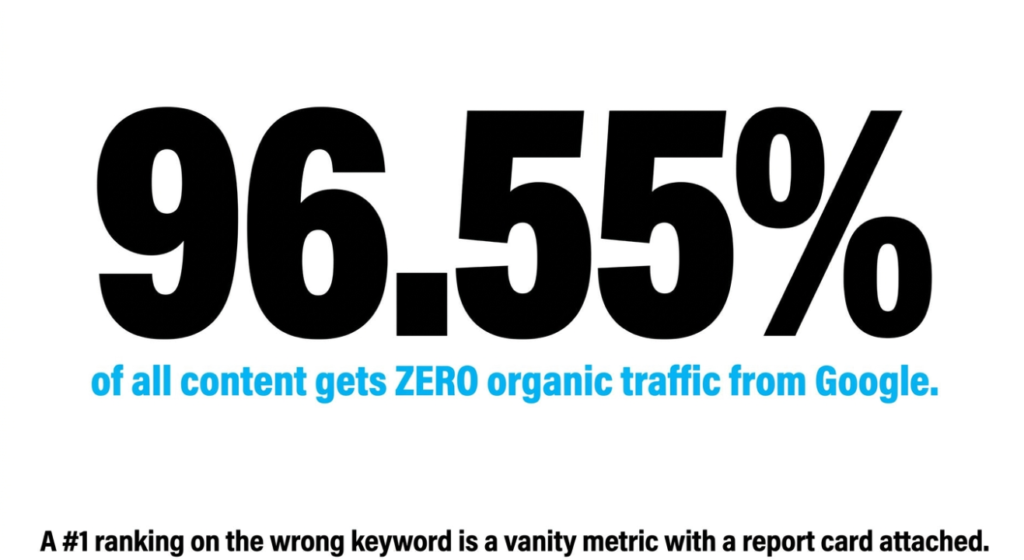
When AI Overviews appear on a search, CTR to the organic results below drops by 25 to 58% depending on the study. 65% of all Google searches now end without a click at all. For informational queries, that number is even higher. The traffic a #1 ranking theoretically deserves and the traffic it actually generates are meaningfully different numbers in 2026, and that gap is widening.
None of this makes SEO a bad investment. Position one still receives significantly more traffic than any other organic position. The point is that the relationship between ranking and revenue has always had a conversion step in the middle, and that step is being treated as optional by most businesses and their agencies.
The Wrong Keyword Problem That Looks Like Success
There is a version of this problem that does not involve SERP features or AI Overviews at all. It involves ranking first for a keyword that does not connect to revenue, and having a dashboard full of green numbers that mean nothing to the business.
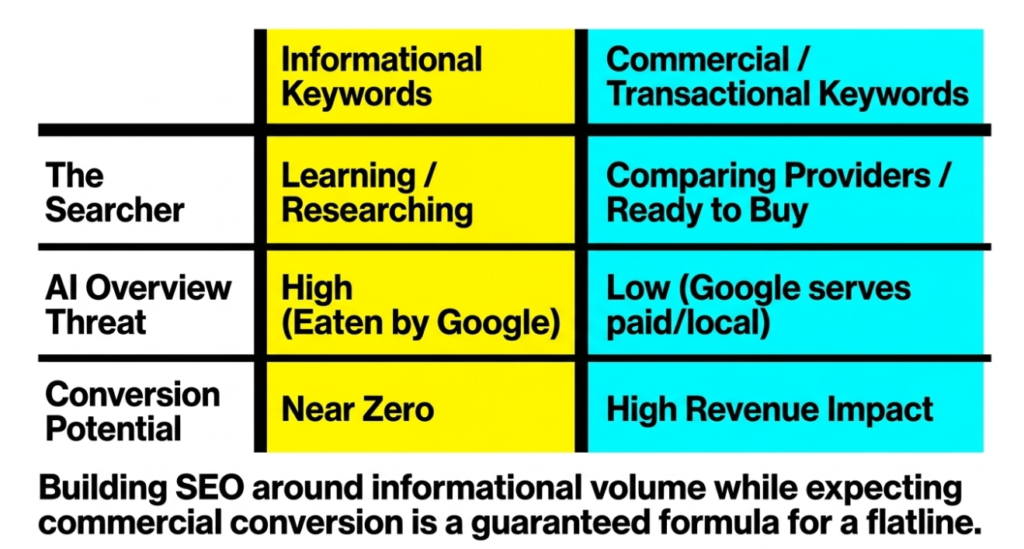
88% of queries triggering AI Overviews are informational. They are how-to searches, definition lookups, research queries. A service business that has built its SEO around high-traffic informational terms is ranking first for questions that buyers are asking before they have decided to hire anyone. The traffic arrives, confirms the information it came for, and leaves without converting. The agency reports impressions. The business owner wonders why none of it turns into calls.
The keyword distinction matters enormously. Commercial and transactional queries, searches where someone is actively comparing providers or ready to make a purchase decision, still produce clicks at rates closer to traditional benchmarks. AI Overviews rarely appear on these queries because Google has a financial reason to serve paid results there instead. A service business ranking for “best plumber near me” or “marketing agency for B2B SaaS” is in a fundamentally different situation than one ranking for “how does SEO work.”
The fix is not a ranking strategy. It is a keyword strategy that starts with buyer intent and works backward to the content, rather than starting with search volume and working forward to a hope.
What Happens to Organic Traffic When the Page Does Not Convert
Assume the keyword is right. The intent is commercial. The ranking is strong. And the page the visitor lands on was never built to convert anyone.
The visitor sees a homepage or a service page built for people who already know the business. There is no clear statement of what the company does for the specific problem the search described. The proof is buried. The CTA says “Contact Us,” which is the lowest-commitment prompt available. The form has eight fields. On mobile, the page takes six seconds to load.
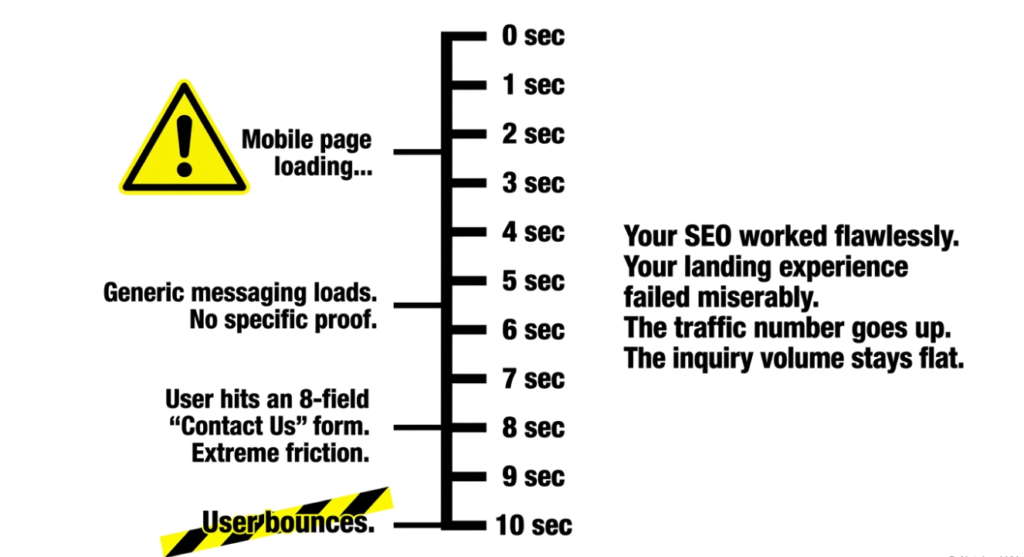
That visitor, who typed a specific problem into a search bar and clicked the first result, is gone in under 10 seconds. The organic traffic number goes up in the weekly report. The inquiry volume stays flat. And the agency’s position is that the SEO is working. Technically, it is. The landing experience is not.
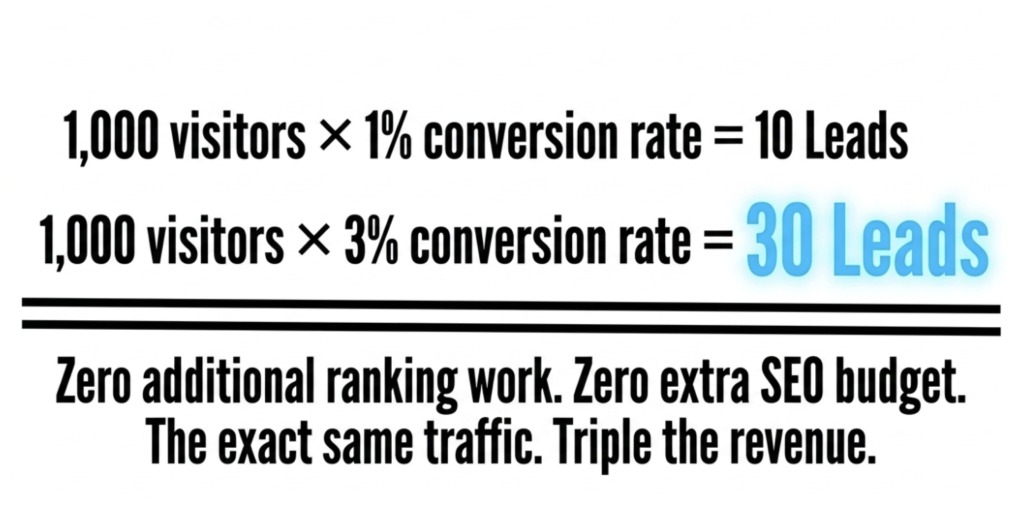
Companies that align SEO with conversion rate optimization see 30 to 50% higher conversion rates from the same organic traffic. The math here is not complicated. If 1,000 visitors arrive at a 1% conversion rate, that is 10 leads. If the conversion rate reaches 3% without any additional ranking work, that is 30 leads from identical traffic. The ranking did not change. The revenue impact tripled.
What Conversion Rate Optimization on Organic Landing Pages Actually Involves
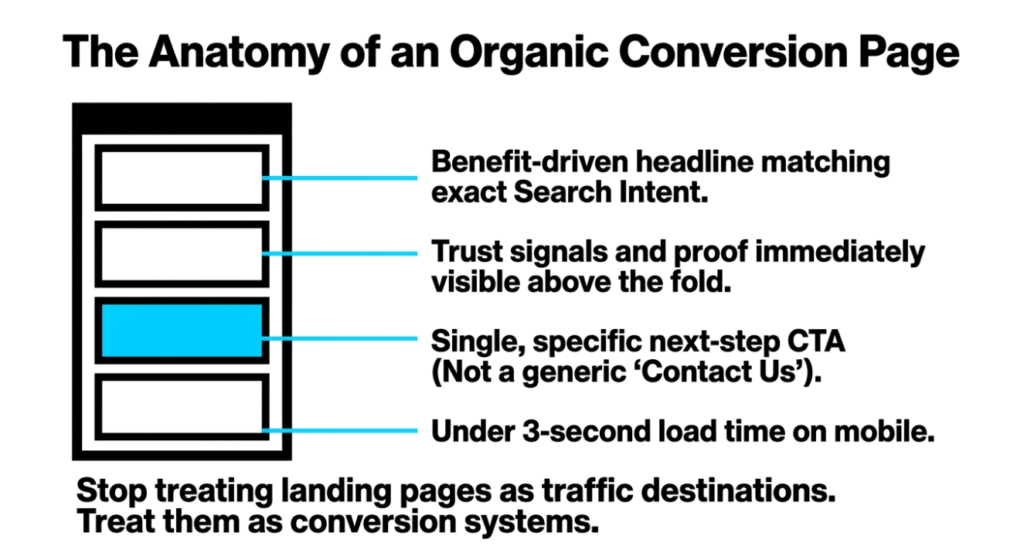
The most common mistake in organic SEO is treating every landing page as a traffic destination rather than a conversion system. The two requirements are related but not identical.
A page optimized for organic traffic needs to match search intent closely, answer the specific question or need the visitor came from, establish trust quickly, and provide a clear path to the next step. Most SEO-focused page work addresses the first requirement and ignores everything after it. Rankings improve. Bounce rates stay high. The business celebrates the ranking.
The specific elements that lift conversion on organic landing pages are not different from conversion optimization principles anywhere else. A benefit-driven headline that reflects the search that brought the visitor. Trust signals visible above the fold. A single, specific CTA that describes a real next step rather than a generic invitation. Page load times under three seconds on mobile. The difference is that SEO teams are not usually accountable for any of those elements, and conversion teams are not usually accountable for whether the page ranks.
That structural separation is where the revenue disappears. When organic traffic and conversion performance are managed by the same goal, the improvement is significant and consistent.
What the Metrics Should Actually Measure
Most SEO reporting covers rankings, organic traffic volume, and impressions. These are all leading indicators, and they are worth tracking. None of them are revenue. A business that evaluates its SEO investment purely on ranking movement and traffic growth is measuring the inputs, not the output.
The metrics that connect SEO to business outcomes are organic conversion rate by landing page, cost per organically acquired lead, lead quality from organic versus other channels, and the percentage of organic traffic arriving on pages optimized for conversion. Those numbers require integrating search performance data with conversion tracking and ideally with CRM data about which organic leads actually closed.
73% of B2B websites experienced significant traffic loss between 2024 and 2025 despite stable or improving rankings. That statistic is partly an AI Overviews story. It is also a keyword intent story and a conversion story. The businesses most insulated from the shift are the ones whose SEO was pointed at commercial-intent searches from the beginning and whose pages were built to convert the traffic that arrived. Ranking first and converting nothing is a solved problem the moment those two objectives share an owner.
FAQ
Why is my website ranking first on Google but not getting leads? There are usually three contributing causes. The keyword may be informational rather than commercial, meaning the visitor is researching rather than buying. The page may not be built to convert, with unclear messaging, missing proof, or a weak CTA. Or the traffic is arriving but abandoning quickly because of page load speed or mobile experience issues. A ranking without a conversion strategy is a visibility win that does not translate to revenue. The fix starts with knowing which cause is primary through conversion tracking and intent analysis.
Does ranking #1 on Google guarantee more business? No. It guarantees more visibility for the specific keyword you ranked for. Whether that visibility turns into leads depends on whether the keyword has commercial intent, whether the search actually produces clicks in an era of AI Overviews and zero-click searches, and whether the landing page converts the visitors who do arrive. Historically, position one delivered around 28% of clicks. That number has dropped to roughly 19% in 2025 and falls further when AI Overviews appear. The revenue impact of a first-place ranking is entirely dependent on what happens after the click.
What is conversion rate optimization for SEO? SEO conversion rate optimization is the practice of improving what percentage of organic visitors take a desired action once they land on your page. It combines the audience-targeting logic of SEO, getting the right visitors to the page, with the behavioral design of CRO, ensuring those visitors convert. In practice it means aligning the page headline to match the search intent, placing proof and CTAs in the positions that reduce friction, optimizing page speed for mobile, and tracking conversion at the page level rather than site-wide. Teams that align both disciplines consistently generate 30 to 50% more revenue from the same traffic.
What keywords actually generate leads from Google? Commercial and transactional intent keywords generate leads because they reflect a buyer who is actively comparing options or ready to hire. Examples include service category searches with location modifiers, comparisons between specific providers, and queries that include words like “cost,” “hire,” “near me,” or specific problem descriptions. Informational keywords generate traffic from people learning about a topic. Those visitors may eventually become buyers, but they are not in the decision window. Building SEO around informational volume while expecting commercial conversion is one of the most common misalignments in digital marketing.
How do I know if my SEO is generating revenue or just traffic? You need conversion tracking tied to organic traffic, ideally connected to your CRM so you can follow leads from organic sessions through to closed revenue. Google Search Console tells you which keywords drive impressions and clicks. Google Analytics tells you which organic visits convert to form fills or calls. A CRM tells you which of those leads closed. Businesses that can answer all three questions understand their organic SEO contribution to revenue. Businesses that can only answer the first question are measuring a ranking, not a return.