
TLDR:
- Facebook’s average organic reach sits at 1.37% of followers. Instagram is around 3.5%. LinkedIn, often held up as the exception, dropped 34% in organic reach year over year. Posting more will not reverse this.
- Paid social media advertising averages $65 per lead. Organic content marketing averages $95 per lead at current staffing costs, though organic leads tend to convert at higher rates over time.
- Social media converts visitors to leads at roughly 0.9% for paid and 1.7% for organic. These are not numbers that replace pipeline. They are numbers that support it.
- 75% of marketing leaders rank paid and organic social as top priorities, but 65% cannot clearly show how those activities connect to business outcomes.
Organic reach is not dead. That framing is convenient and somewhat overstated. What it is, is marginal. Facebook’s organic reach averaged 1.37% of followers in 2024. Instagram sits around 3.5%, and that number dropped 18% from the year before. LinkedIn, which service businesses tend to treat as the reliable organic channel, shed 34% of its organic reach year over year. If you have 2,000 followers on Facebook and post something today, roughly 27 people will see it without paid amplification.
The honest conversation for a service business is not “organic or paid.” It is “what job is each one doing, and am I managing both with that clarity?” Most businesses are not. They have organic accounts that feel like content obligations and paid accounts that bleed budget without a coherent strategy between them.
When neither side is working toward the same outcome, you are not running a social strategy. You are running two unrelated activities and wondering why the sum does not add up.
What Organic Social Media Actually Does for a Service Business
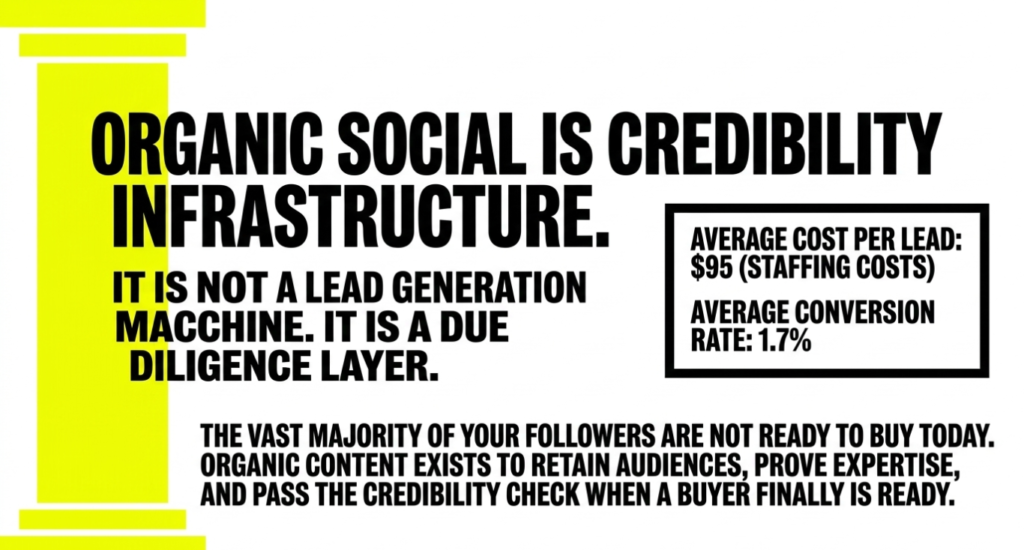
That said, organic social has a job worth doing. It just is not the job most businesses use it for. When a potential buyer sees a paid ad, reads a referral mention, or finds a website through search, the next thing most of them do is look at the social profile. What they find there either increases or decreases their confidence in the business. A profile with sharp, specific, credible content earns that next step. A profile with sporadic posts, generic tips, or a last update from five months ago does not.
Organic social is credibility infrastructure. It is a due diligence layer. It does not generate the inquiry on its own, but it frequently determines whether the inquiry generated through another channel actually converts. That is a real job. It is just not the job of paid acquisition, and the mistake is treating the two as interchangeable.
How Paid Social Media Lead Generation Actually Works for Service Businesses
Paid social is where service businesses can generate predictable volume, but it requires the same structural clarity as any other paid channel: the right audience, the right offer, the right landing experience, and realistic expectations about conversion rates.
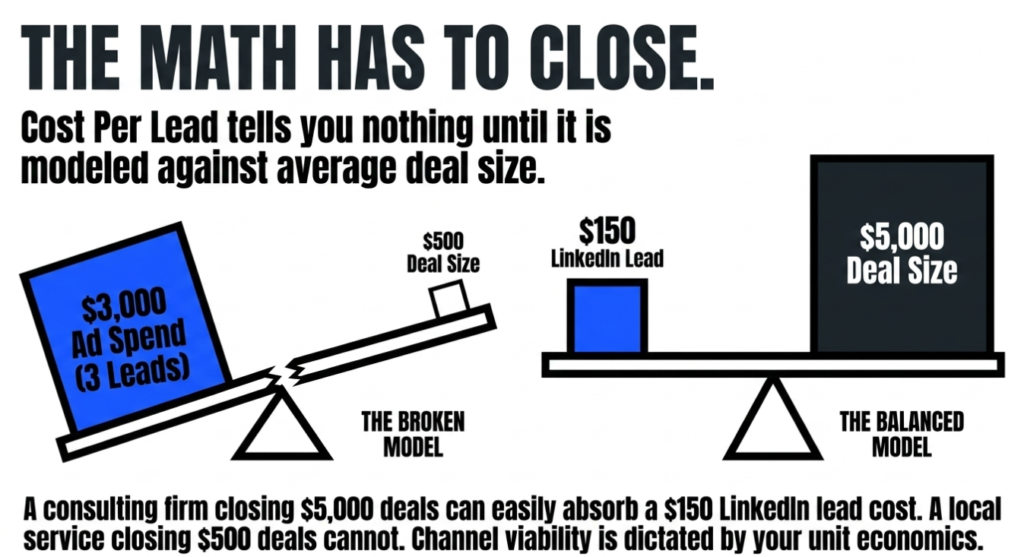
Social media in B2B contexts converts paid visitors to leads at roughly 0.9%. In consumer service categories it runs higher, but the floor matters. That number is not alarming if the ad spend and conversion economics make sense against average deal size. It is alarming if you are spending $3,000 a month to generate three leads from a service with a $500 average transaction. The math has to close before the channel earns its budget.
Facebook’s average cost per lead is $27.66. LinkedIn’s ranges from $15 to $350 depending on industry and targeting. For service businesses with meaningful deal sizes, legal, financial, consulting, home services, marketing, both platforms can produce positive unit economics when campaigns are structured around the buyer’s problem and the offer is specific enough to earn a click. The failure mode is running brand awareness creative against a conversion objective, measuring vanity metrics rather than pipeline, or pointing paid traffic at a homepage that does not convert. Paid social does not fail on its own. It fails when it is disconnected from the conversion infrastructure it needs to work.
Why Most Service Businesses Treat Organic and Paid as Separate Operations
Most businesses manage their organic and paid social accounts separately. A marketing coordinator handles the Instagram posting. A paid ads vendor runs the Facebook campaigns. Neither is aware of what the other is doing, and neither is accountable to the same outcome. This separation is the single most common reason service businesses spend real money on social and cannot show what it produced.
The practical costs of this separation are real. Organic content that performs well rarely gets amplified with paid because no one is watching both at once. Paid targeting that generates clicks rarely informs what organic content gets created because the two teams are not in the same room. Attribution reports show one set of metrics on the paid side and a different set on the organic side, and neither report answers the question a business owner actually needs answered: is social media generating qualified clients at a profitable cost?
65% of marketing leaders say they want to see a direct connection between social media activity and business goals. Most of their agencies cannot show one. The gap is not always about execution quality. It is often about whether the organic and paid sides were ever pointed at the same goal to begin with.
What a Connected Social Media Marketing Strategy Looks Like
A connected strategy starts with one question: what is a qualified lead worth to this business, and which sequence of social touchpoints gets a potential buyer from first encounter to that conversation? The answer to that question tells you exactly what organic content should say, what paid campaigns should target, and what success looks like in each report.
In practice, this tends to look like organic content that establishes a genuine point of view, paid campaigns that amplify the strongest performers and reach cold audiences who match the buyer profile, and retargeting that keeps the business in front of people who have already clicked but not yet acted. When an organic post generates strong engagement, that is a signal to put budget behind it. When a paid campaign produces clicks that do not convert, that is a signal to examine the landing destination. In an integrated system, those signals travel across both sides.
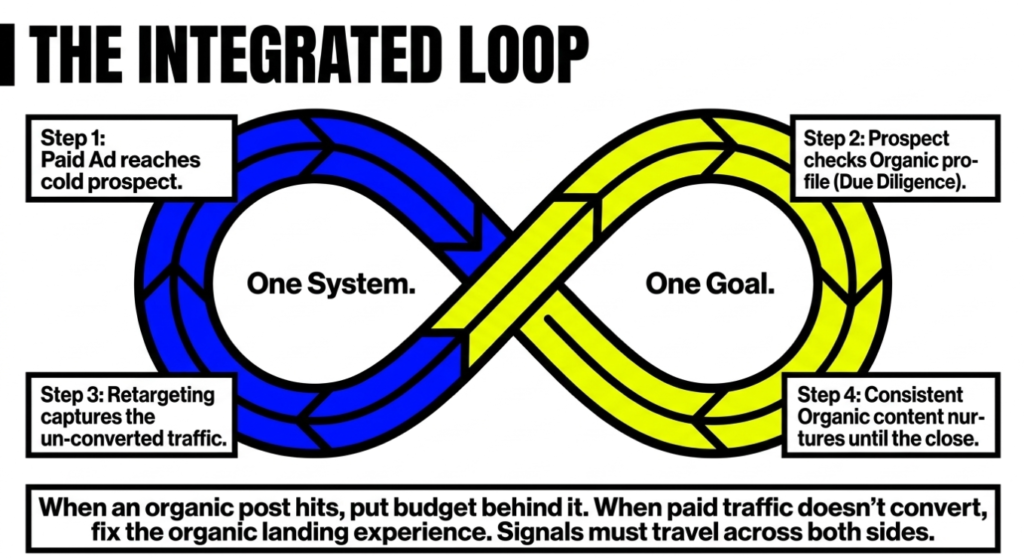
The businesses that generate consistent pipeline from social are the ones that have stopped asking which channel is better and started asking how to make both serve the same objective. Big Click Energy manages both sides as one system because disconnected social spending is how you end up with reports that look active and pipelines that stay flat. The question that matters is not how many posts you published. It is how many conversations started because of them.
FAQ
Is organic social media still worth it for a service business? Yes, but for a different reason than most businesses expect. Organic social no longer delivers meaningful reach or consistent lead volume for most service business accounts. What it does provide is a credibility layer that buyers check before deciding to move forward. When your paid ads or referral network drives someone to your profile, strong organic content is what earns the next step. Treating organic as a lead generation channel will produce disappointment. Treating it as a trust-building asset that supports other acquisition channels is where it adds real value.
What is the difference between organic social and paid social? Organic social refers to content posted without paid promotion. It reaches only a fraction of your existing followers due to platform algorithm constraints. Paid social involves paying to have content or ads delivered to a specific, targeted audience, including people who do not follow you. For service businesses, organic social builds credibility and retains existing audiences while paid social reaches new potential buyers and drives direct response. The two serve different functions and should be measured differently.
How much does paid social lead generation cost for a service business? Facebook’s average cost per lead is $27.66. LinkedIn ranges considerably wider, from $15 to $350, depending on industry and targeting precision. Whether those numbers are profitable depends entirely on average deal size and close rate. A service business closing deals worth $5,000 can absorb a $150 LinkedIn lead cost. One closing $500 deals cannot. The cost per lead number alone tells you nothing until it is modeled against customer acquisition cost and lifetime value.
Should a service business focus more on organic or paid social? For most service businesses, paid social should be the primary driver of new audience reach and lead volume. Organic social should be consistent enough to pass a credibility check for buyers who discover the business through other channels. If budget is limited and the choice is forced, paid social generates more predictable, attributable pipeline for service businesses than organic alone. If organic is the only investment, it needs a much more focused content strategy than “post regularly” to produce any measurable outcome.
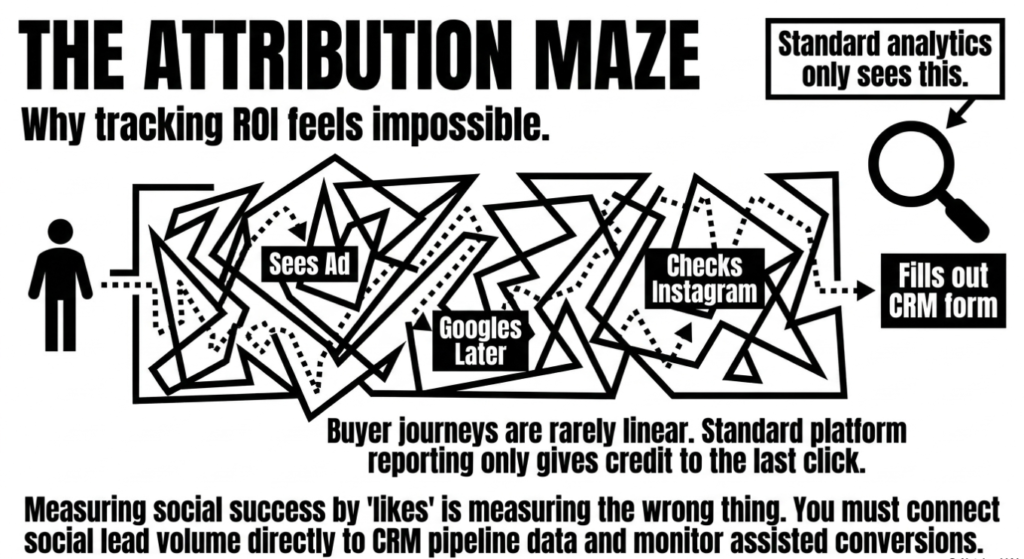
Why is it hard to track social media ROI for service businesses? Social media attribution is genuinely difficult because buyer journeys are rarely linear. A potential client might see an Instagram post, ignore it, find the business again through Google, and then go back to social to check credibility before making contact. None of those intermediate steps get credit in standard platform reporting. The most reliable approach is tracking assisted conversions in analytics, monitoring profile visits from paid campaigns, and connecting social lead volume directly to CRM data. Businesses that measure social success by likes and follower counts are measuring the wrong things, which is why the ROI appears unclear.