

TLDR:
- 68% of businesses admit they waste money on ineffective digital ads. The average wasted marketing budget across industries runs between 26% and 60% depending on the study. The number is high because most businesses never audit what is actually happening.
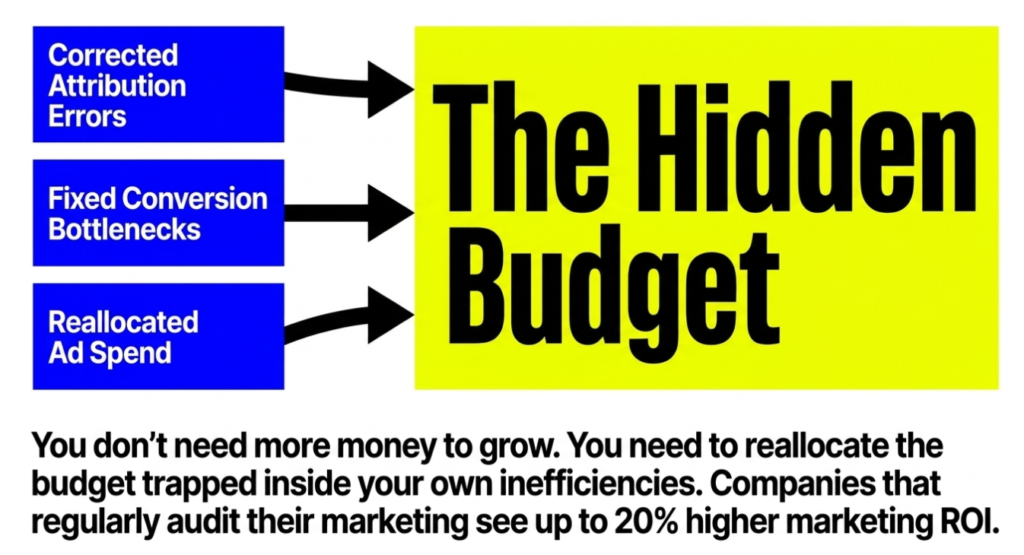
- Companies that regularly audit their marketing see up to 20% higher marketing ROI. Most businesses skip this entirely, or commission audits that never produce an uncomfortable finding.
- 59% of CMOs say they have insufficient budget to execute their strategy. An audit is often the fastest way to find the budget that already exists but is not working.
- Attribution errors are among the most common audit findings. Most paid campaigns look better in the dashboard than they perform in the pipeline, and that gap rarely surfaces until someone looks.
Most marketing audits are not audits. They are sales decks. An agency reviewing your existing setup has a financial incentive to find problems their services solve. A vendor assessing your current performance has every reason to make the current vendor look bad and themselves look necessary. What most businesses get from a so-called audit is a formatted document that confirms what the agency already planned to propose.
A genuine marketing audit is uncomfortable. It tells you things you may not want to hear about money you have already spent. It identifies the parts of your marketing that appear to be working but are not connected to revenue. It finds the parts you ignored that were quietly generating leads the whole time.
The audits that most businesses need and the audits most businesses receive are two entirely different documents.
What a Marketing Audit Is Actually Supposed to Cover
A real marketing audit is a systematic review of everything your business is doing to acquire and retain customers, measured against the outcomes those activities are producing. That means the website, paid channels, organic channels, email, content, and the data infrastructure that ties all of them together. It is not a report about your ad account. It is not a website redesign pitch. It is an honest diagnosis of where revenue is and is not coming from, and why.
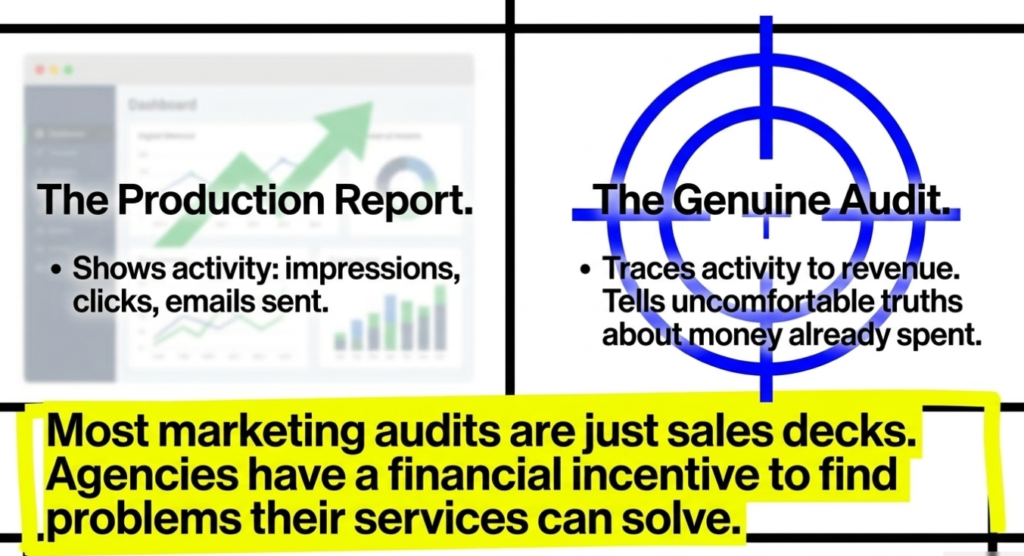
The distinction that most audits miss is the difference between activity and outcome. A marketing audit that shows you how many posts were published, how many emails were sent, and how many ad impressions were recorded is a production report. An audit is supposed to trace those activities to actual business results. How many qualified leads came through each channel, at what cost, and how many of those closed? If the audit cannot answer those questions, it is not an audit. It is a lookback.
Most businesses have never seen the audit version. They have seen the lookback version with “key insights” added to make it feel strategic. The two do not produce the same result.
What Honest Audits Find That Most Agency Reports Do Not
The most common findings in an honest marketing audit tend to fall into a small number of categories, and almost none of them are flattering.
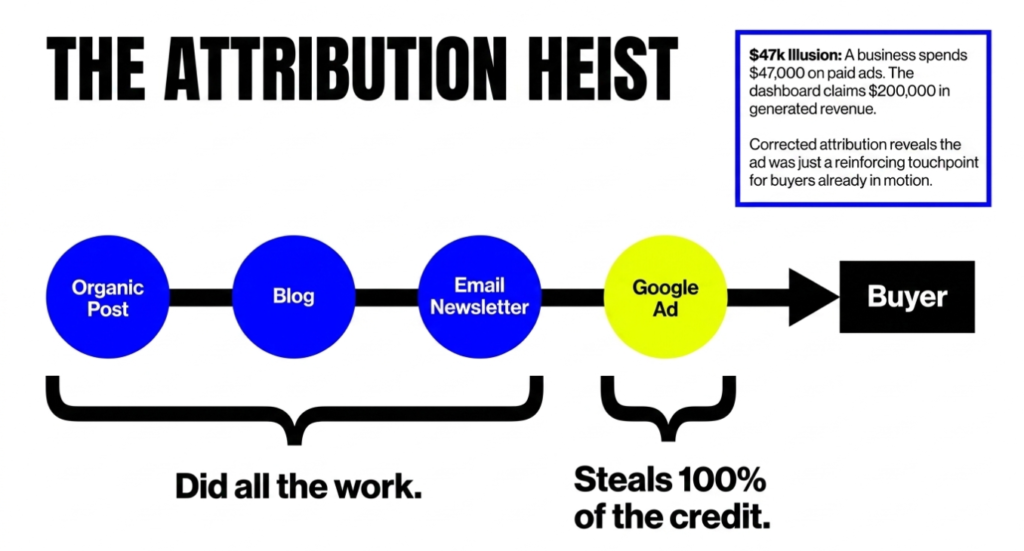
The first is attribution errors. Paid campaigns regularly look profitable in dashboards because the platform reports every click from a buyer who converted, even if the buyer was already in the pipeline and would have converted without the ad. Last-click attribution inflates the apparent performance of paid search in particular. A business can spend $47,000 on paid campaigns and believe they generated $200,000 in revenue, when the actual incremental contribution was a fraction of that. Corrected attribution often reveals that a channel widely considered the primary revenue driver was actually a reinforcing touchpoint for buyers already in motion.
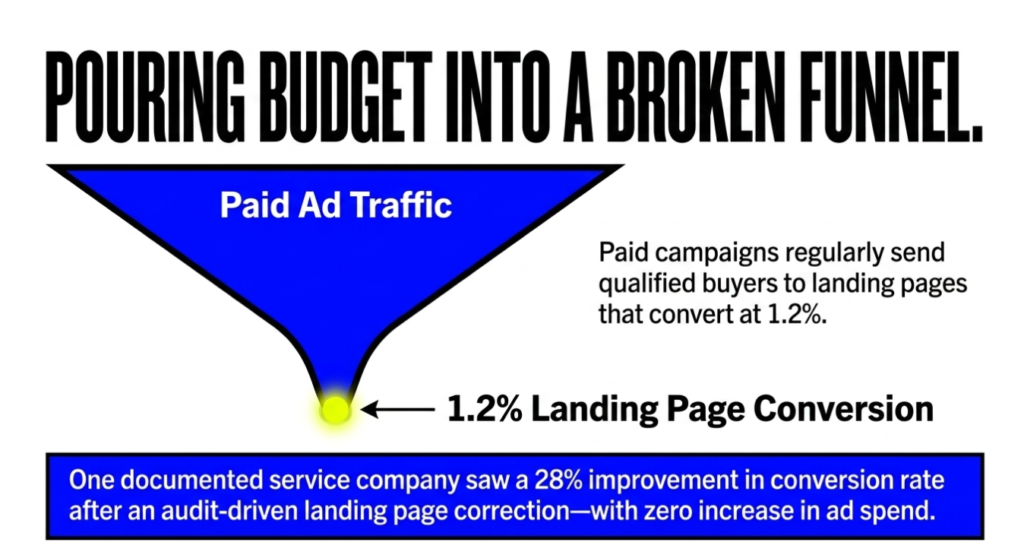
The second is website conversion performance that no one is monitoring. Most businesses track traffic. Very few track the conversion rate on that traffic consistently enough to notice when it drops. An honest audit will find that paid campaigns are sending qualified buyers to landing pages that convert at 1.2%, and that a structural fix to the hero section and CTA would produce more revenue than doubling the ad budget. One documented example of a service company discovering this pattern shows a 28% improvement in conversion rate with no increase in ad spend after an audit-driven landing page correction.
The third is channel misattribution. A business convinced that Google Ads is driving everything often discovers in an audit that organic traffic from a two-year-old blog post is generating a substantial fraction of inbound leads, uncredited because the last-click model gave Google Ads the conversion. The implications for budget allocation are significant and almost never surface in a vendor’s standard reporting.
What the Data Layer of an Honest Marketing Audit Examines
Before an audit can assess channel performance, it has to verify whether the data being reported is accurate. This step gets skipped in most audits because it is unglamorous and occasionally reveals that the person doing the reporting has been reading bad numbers for months. It is also the most important step.
Tracking setup errors are common and often go unnoticed for extended periods. Conversion events misconfigured in Google Analytics, double-firing pixels inflating conversion counts, forms that submit but do not trigger the confirmation event. Every one of these produces a version of performance that looks better than reality. An audit that does not verify tracking integrity is building its entire analysis on a foundation that may be unreliable.
CRM data hygiene is the second layer. If marketing is generating leads that the CRM is not capturing consistently, or if lead source data is missing or inconsistent, then the marketing-to-revenue attribution is already broken before the analysis starts. 36% of marketers regret their technology investments. A significant portion of that regret traces back to tools that were never set up correctly and therefore never produced accurate data that anyone trusted or used.
The data audit is often where the most revealing findings live, and it is consistently the section most agencies skip because it requires access to systems they do not control and produces findings that reflect poorly on everyone involved.
What Happens to Organic and Content Performance in a Real Audit
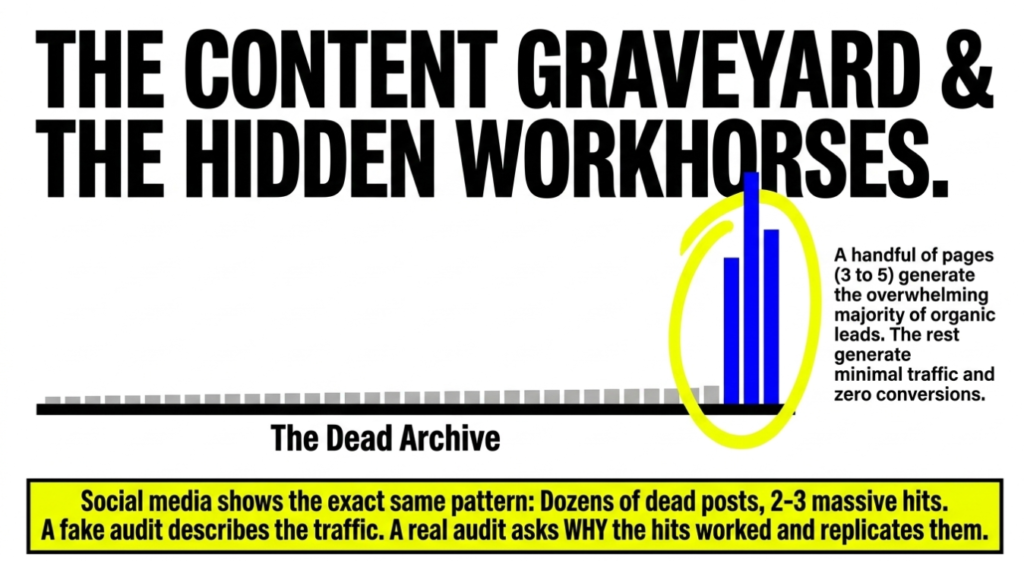
Content and organic performance are where most businesses discover the widest gap between perceived and actual contribution. The typical finding is that a handful of pages, sometimes as few as three to five, are generating the overwhelming majority of organic leads. The rest of the content archive is generating minimal traffic and zero conversions. That is not a content quality problem. It is a prioritization problem that has been invisible because no one ran the numbers.
The inverse finding is equally common. A business that has deprioritized content because “SEO takes too long” often discovers in an audit that organic search is already sending meaningful traffic to the website. The traffic just is not converting because no one optimized the landing experience for organic visitors. The channel was working. The funnel was broken. These two things look identical in aggregate traffic reports and require a channel-by-channel breakdown to separate.
Social media performance in a content audit almost always reveals the same pattern. Dozens of posts with minimal engagement, two or three pieces that performed significantly, and no documented reason why the two or three worked when the others did not. A content audit stops at description. A real audit asks what was different about the high performers and builds a forward strategy around replicating that.
What a Marketing Audit Report Should Actually Deliver
A marketing audit that does not produce a prioritized action list is a research exercise. The output that matters is not a document showing you what happened. It is a ranked set of interventions sorted by expected impact relative to the effort required, along with a clear rationale for each.
The highest-value findings in most small business audits follow a consistent pattern. A tracking or attribution issue inflating apparent performance in one channel and deflating apparent performance in another. A conversion bottleneck on the primary landing page that is absorbing significant paid traffic and producing poor returns. An underperforming channel receiving budget that should be reallocated. An organic or referral channel producing leads quietly, without strategic attention or reinforcement.
None of these findings require additional budget to fix. They require honest diagnosis and execution against a priority list. That is the difference between a marketing audit and a pitch. Big Click Energy conducts audits that start with the revenue data, not the service menu. When the findings point toward a fix that the business can execute without additional support, that is what the audit says. For businesses that have been told their marketing is “looking good” for several consecutive quarters while revenue stays flat, that kind of honest assessment tends to be overdue.
FAQ
What is a marketing audit and what does it include? A marketing audit is a systematic review of everything a business does to acquire and retain customers, measured against the business outcomes those activities are actually producing. A complete audit covers website performance and conversion rates, paid channel attribution and spend efficiency, SEO and organic traffic analysis, content performance, email and CRM data integrity, and brand consistency across channels. The objective is not to confirm existing activity but to identify where money and effort are being well-used and where they are not.
How often should a business do a marketing audit? For most service businesses doing $500K to $2M in revenue, a full marketing audit once per year is a reasonable baseline, with a lighter quarterly review of key channel performance. A full audit becomes more urgent when revenue growth has plateaued despite steady marketing spend, when a new agency or vendor is being onboarded, when a major channel has recently been changed or added, or when the business cannot clearly explain where its best clients are coming from.
What is the most common thing a marketing audit finds? Attribution errors and conversion bottlenecks are the two most consistent findings. Attribution errors mean that paid channels are receiving credit for conversions they did not drive, which distorts budget decisions. Conversion bottlenecks mean that traffic is arriving but not converting, usually because a homepage, landing page, or contact form is not structured around what a buyer needs to see before taking action. Both problems are fixable without additional spend. Both are often invisible until someone specifically looks for them.
How is a marketing audit different from a standard agency report? Standard agency reports show activity metrics: impressions, clicks, sessions, follower counts. A marketing audit connects activity to revenue outcomes and asks whether each channel is producing qualified pipeline at a sustainable cost. An agency report is designed to demonstrate effort and justify a retainer. An audit is designed to tell the truth about what is working, what is not, and what should change. The two documents rarely say the same things, which is why genuine audits are uncommon from the vendors they assess.
Can a marketing audit find money without increasing the budget? Yes, and this is frequently what happens. When attribution errors are corrected, budget allocation shifts toward channels that are actually driving revenue. When conversion rates improve on existing traffic, the same ad spend produces more leads. When an organic channel is identified as underused, it can be developed without paid amplification. Businesses that have been told they need more budget to grow often discover in an honest audit that their existing budget is poorly distributed, and that reallocation produces better results than additional spending.