
TLDR:
- Visitors form an opinion of your website in about 50 milliseconds. You have roughly 10 seconds to answer three questions before most of them leave. Most service business homepages fail at least two of those questions.
- The average bounce rate across industries is 47.4%. Gartner research shows that poor digital experiences reduce lead qualification by up to 50%. High bounce rates are not a traffic problem. They are a clarity problem.
- B2B sites loading in one second convert at three times the rate of five-second sites. The average mobile load time is still 8.6 seconds. Your homepage is likely losing visitors before they read a word.
- 42% of consumers trust online reviews as much as personal recommendations. Most service business homepages either bury their proof or remove it entirely when a designer calls the page “too busy.”
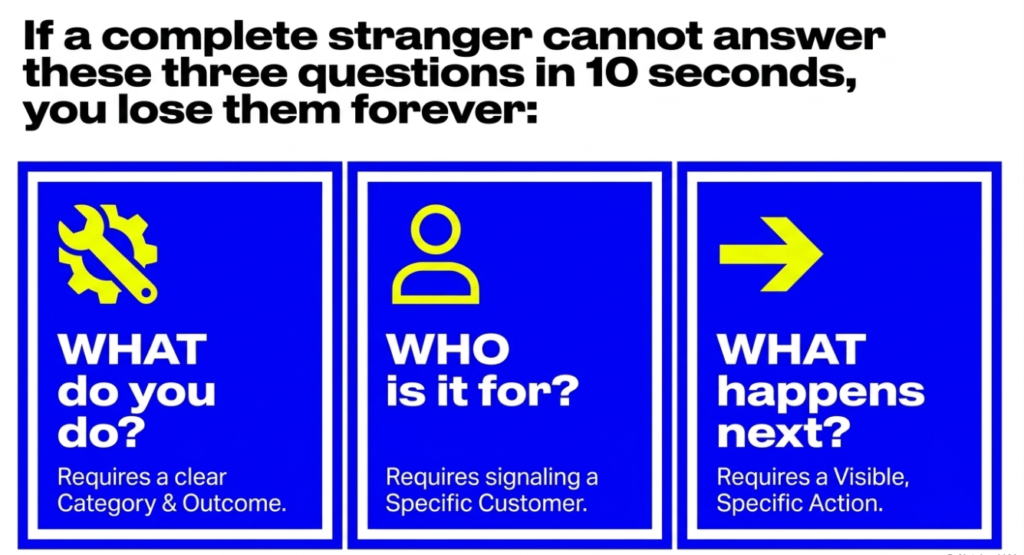
Pull up your homepage right now. Set a timer for 10 seconds. Can a complete stranger answer three questions before the timer runs out: what does your business do, who is it for, and what should they do next? If the answer is no, you have just run the 10-second homepage test, and your website has failed it.
Most business owners are too close to their own websites to see this clearly. You know what the company does. You have read the headline so many times it does not register as confusing. The assumptions you carry into the page are the same ones your visitors do not have, and that gap is where leads disappear.
The problem is not usually design quality. It is information architecture. Beautiful websites with unclear offers fail this test every day. Plain websites with clear offers pass it and generate inquiries. The two variables are not the same variable.
What the 10-Second Homepage Test Is Actually Measuring
The test is not about speed reading. It is about message clarity at a glance. A visitor lands on your homepage with no prior knowledge of your business, no obligation to stay, and a dozen alternatives one click away. In those first seconds, they are running a fast, silent calculation: does this page seem like it is for me, does it tell me what I need to know, and is there something here worth investigating further?
Visitors form a judgment of a website’s visual appeal, layout, and clarity within 50 milliseconds. That initial verdict influences whether they stay to read anything at all. But the 10-second threshold is where the content judgment happens. If they cannot identify what the business does and whether it applies to them within that window, most leave. The cross-industry median bounce rate is 47.4%, and for service businesses specifically, the most cited cause is a mismatch between what the visitor expected and what the page actually communicated.
The three questions the test is checking are specific. “What does this company do?” requires a headline that describes an actual service or outcome, not a brand statement. “Who is it for?” requires the page to signal a specific type of customer, even implicitly. “What should I do next?” requires a visible, specific call to action above the fold. Visitors should not need to scroll to answer any of those three. When they do, the test fails.
Why Most Service Business Homepages Fail the Headline Question
The most common point of failure is the headline. A service business homepage headline should answer “what do you do?” in plain language oriented around the buyer’s outcome. What most businesses have instead is a brand statement, a slogan, a mission expression, or a piece of clever copy that sounds good in a brainstorming session and communicates almost nothing to a first-time visitor.
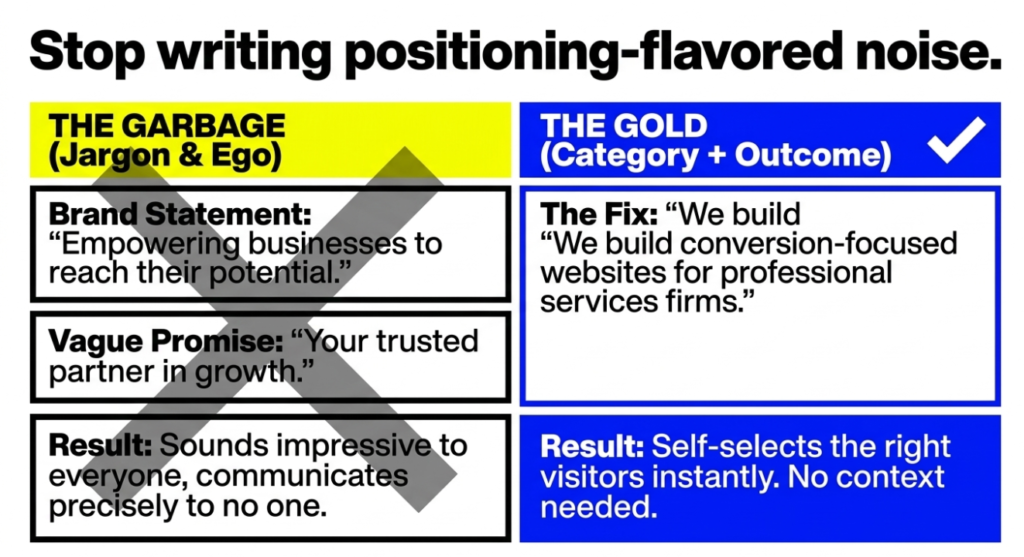
Phrases like “Empowering businesses to reach their potential” or “Your trusted partner in growth” do not answer the question. They are positioning-flavored noise. The visitor still does not know if this business builds websites, sells insurance, does accounting, or ships equipment. Those headlines are not wrong because they sound bad. They are wrong because they delay the answer to the most important question a visitor is asking.
The fix is structural, not creative. A homepage headline for a service business should communicate the category and ideally the outcome. “We build conversion-focused websites for professional services firms” answers the question. It also self-selects the right visitors, which is the second function a headline has to perform. A headline that tries to sound impressive to everyone communicates precisely to no one.
Eye-tracking research confirms that visitors spend close to 5.6 seconds on the primary written content nearest the hero image before making a decision to scroll or leave. That is not enough time to decode a clever tagline and infer a category.
The Trust Gap That Homepage Social Proof Is Supposed to Close
Even when the headline works, most service business homepages introduce a different failure at the second layer: no visible proof. A buyer who has just read that your company does good work for businesses like theirs now has a follow-up question: says who? 42% of consumers trust online reviews as much as personal recommendations. The page has about two seconds of sustained attention to answer the trust question before the visitor’s instinct to close the tab starts winning.
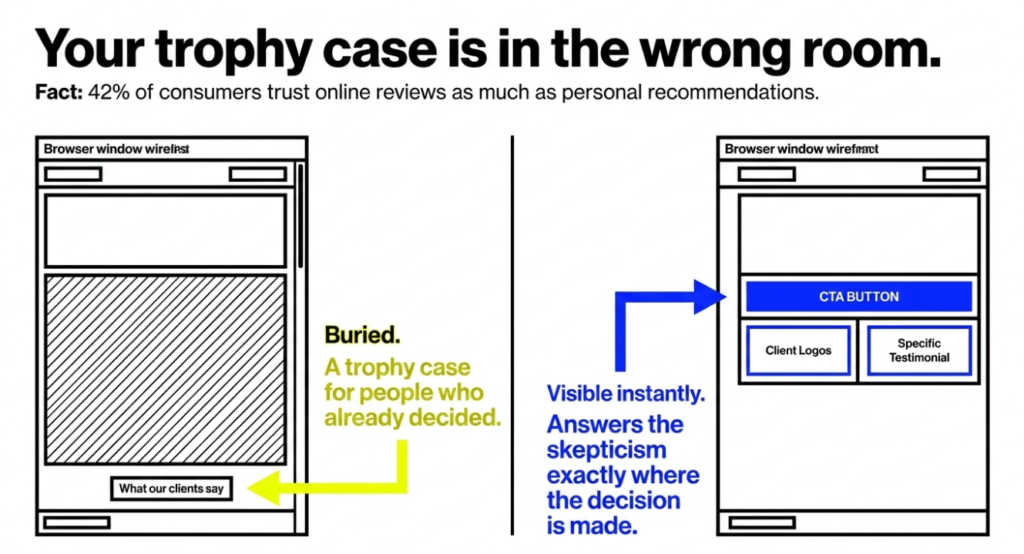
Most service business homepages put testimonials somewhere on the page, but almost never where the skepticism lives. A section labeled “What our clients say” near the footer is not social proof for a buyer making a decision above the fold. It is a trophy case for visitors who already decided to stay. The placement matters as much as the proof itself. Displaying a strong testimonial or a recognizable client logo directly adjacent to the primary CTA is where proof does the most work.
Poor digital experiences reduce lead qualification by up to 50%. A significant portion of that reduction traces back to the moment a visitor forms a trust question the page cannot answer quickly. The fix is not adding a testimonials page. It is moving the right proof to the right location on the existing page, specifically above the fold and adjacent to the CTA. That single structural change consistently produces meaningful conversion lift without touching ad spend.
Page Speed as a Lead Generation Problem
Many service businesses have done the work to answer the three questions clearly. The headline describes the service. The proof is visible. The CTA is specific. And the homepage is still not generating leads at the rate the traffic volume should support. The diagnosis is usually speed.
B2B sites loading in one second convert at three times the rate of sites loading in five seconds. The average mobile load time is still 8.6 seconds, and 53% of mobile visitors abandon a page that takes longer than three seconds to load. For a business spending money on paid ads or investing in organic traffic, those numbers mean a substantial fraction of visitors are deciding to leave before they see anything the page contains.
The homepage could pass the 10-second test for every visitor who actually sees it. The problem is that a large share of mobile visitors never do. They bounced at second four, before the hero image finished rendering, before the headline appeared, and definitely before any CTA registered. That is not a content problem. It is a technical problem that presents as a lead generation problem because the traffic numbers look fine but the inquiry volume does not follow.
A page load audit is one of the highest-leverage diagnostic steps available because the fix is often straightforward. Oversized image files, unoptimized code, and plugin bloat from popular website builders are the most common culprits, and addressing them typically does not require a full redesign.
The Homepage CTA Problem Nobody Talks About
Assuming the visitor read the headline, felt the trust signals were adequate, and the page loaded fast enough to keep them around, the last place the 10-second test fails is the CTA. Specifically, the CTA says nothing.
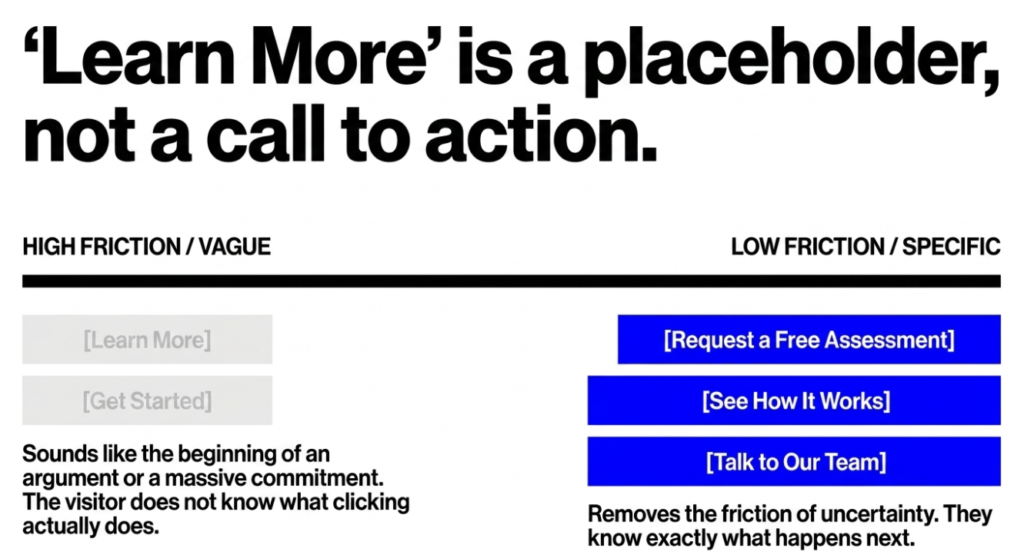
“Learn More” is not a call to action. It is a holding placeholder that communicates no specific next step, no commitment level, and no reason to click. The same is true of “Get Started,” which sounds like the beginning of an argument without a clear destination. The visitor does not know if clicking means signing a contract, filling out a long form, or just seeing a phone number.
Specific, low-friction CTAs consistently outperform generic ones. “Request a Free Assessment,” “See How It Works,” or “Talk to Our Team” each tell the visitor what happens next and how much commitment the next step requires. That specificity removes the friction of uncertainty. A visitor who knows what clicking means is more likely to click than one who does not.
Big Click Energy approaches homepage design as a three-question test with a speed floor and a trust layer. If the page fails the 10-second test, no amount of additional traffic will fix the lead volume problem. Optimizing the homepage for the three questions is consistently the most efficient intervention available before any budget gets added to campaigns.
FAQ
What is the 10-second homepage test? The 10-second homepage test asks whether a first-time visitor can identify what the business does, who it serves, and what to do next within 10 seconds of landing on the homepage. It is a practical measure of homepage clarity, not a formal usability tool. A visitor who cannot answer those three questions in that window is statistically unlikely to scroll further or submit a form. Most service business homepages fail at least two of the three questions, which explains why traffic volume and lead volume often diverge.
Why is my website getting traffic but no leads? The most common explanations are unclear messaging in the hero section, missing or misplaced social proof, slow page load times, and a CTA that does not clearly communicate the next step. Traffic is a separate variable from conversion. A homepage can receive thousands of visitors and generate almost no inquiries if the clarity, trust, and speed conditions are not all met simultaneously. The 10-second test identifies which of the three conditions is failing first.
What should a homepage headline actually say for a service business? It should describe what the business does and who it is for, oriented around the buyer’s outcome. “We help professional services firms generate more qualified leads through conversion-focused web design” is a homepage headline. “Empowering businesses to reach their potential” is not. The test is whether a complete stranger reading the headline for the first time could correctly explain what the company does without needing additional context. If they could not, the headline needs rewriting before anything else on the page changes.
What is a good homepage conversion rate for a service business? Across industries, average website conversion rates sit around 2.9%. The top performers in professional services and B2B categories reach 5% to 11% with strong messaging and well-structured pages. If your homepage is converting below 1.5% on consistent traffic, something structural is broken. The most likely candidates are headline clarity, social proof placement, CTA specificity, and page load speed. More traffic without fixing those problems will not improve the lead rate.
Does page load speed really affect lead generation? Yes, directly and significantly. B2B sites that load in one second convert at three times the rate of five-second sites. The average mobile load time is still above eight seconds. That gap means a substantial portion of mobile visitors leave before seeing the content, CTA, or proof the page contains. Businesses often attribute this loss to audience quality or ad targeting when the real problem is technical. Checking load speed through Google PageSpeed Insights is a five-minute diagnostic that often points to an improvement with a faster return than any copy or design change.