
TLDR
- The SEO results timeline most agencies quote is optimistic for most business situations. That is documented, not speculative.
- The SEO benchmarks most commonly reported are not the same as the ones most connected to revenue.
- Content quality and searcher engagement are the two fastest-rising signals in Google’s algorithm. Most reporting does not cover them in meaningful depth.
- Organic traffic growth that does not come with engagement signals tends not to hold when rankings arrive.
- SEO agency expectations set in a proposal deserve to be revisited with specific questions around month four, not month twelve.
Oh good. You’re here because your SEO results timeline is not going the way your agency promised. And you’re confused. And slightly betrayed. And wondering if maybe, just maybe, someone sold you a story.
Yes. They did. Congrats on catching up.
SEO benchmarks are and I cannot stress this enough the horoscopes of digital marketing. Vague enough to feel true. Specific enough to sound like someone did math. Almost never connected to whether your phone actually rings more than it did before you started paying for this. But sure, keep staring at that impressions graph like it owes you money.
Let’s go through this slowly because apparently we need to.
What You Were Promised vs. SEO Benchmarks
No two SEO results timelines are identical, but the gap between what gets promised and what tends to happen follows a recognizable pattern.
| What Most Agencies Quote | What the SEO Benchmarks Actually Show |
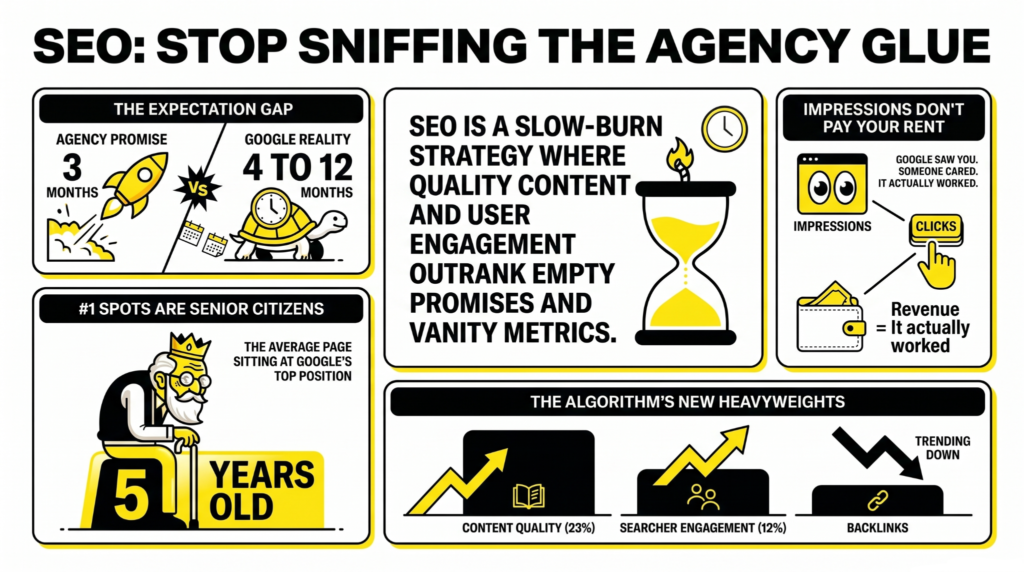
| Results in 3 to 6 months | Google’s own guidance: 4 to 12 months |
| Rankings as proof of progress | Rankings without clicks are impressions, not results |
| Backlinks as the main deliverable | Backlinks account for 13% of Google’s algorithm, down from 15% two years ago |
| Traffic growth as the goal | Organic traffic growth without conversion is an expense with extra steps |
| “We’re building momentum” | The average page at position #1 is five years old |
“The average page sitting at Google’s number one position is five years old. Your agency told you six months. Interestingly, both of those things are true at the same time.”
If your SEO agency expectations were built on the three-to-six-month window and you are currently somewhere past that, you are not alone and you are not imagining things. Big Click Energy has that conversation every week with business owners who are tired of being told to wait. If you want a straight answer about where your SEO results timeline actually stands, the free audit at big-click-energy.com does not come with a momentum speech.
SEO in the First Three Months
The first months of any SEO results timeline are almost entirely invisible to the untrained eye. Here is what competent agencies are building during that window, and why none of it shows up in your organic traffic growth numbers yet.
- Month 1: They are auditing your site, fixing crawl errors, and doing keyword mapping. This is real work. It is also completely invisible to you. You will see nothing.
- Month 2: On-page optimization and internal linking. Google starts noticing. Your impressions in Search Console may tick upward. Do not celebrate yet. Impressions mean Google saw you. Clicks mean someone cared. Revenue means it worked. Most reports only celebrate the first one.
- Month 3: Content starts going live. Early movement on low-competition keywords. Clicks remain modest. Leads remain zero.
This is normal. This is documented. This is exactly what a competent agency would have told you upfront instead of letting you expect phone calls by week eight.
What this period does not typically produce: meaningful organic traffic growth, leads, or calls. If your SEO agency expectations are being managed with impressions data alone at this stage, that is worth clarifying before month six arrives.
“Impressions mean Google saw you. Clicks mean someone cared. Revenue means it worked. These are three different numbers and most reports only celebrate the first one.”
SEO Benchmarks That Actually Connect to Revenue
Most SEO benchmarks are built around the metrics that are easiest to show going up. That is not necessarily deceptive. It is, however, selective.
According to First Page Sage’s 2025 algorithm analysis, here is what Google actually weights:
| Ranking Factor | Algorithm Weight | Trend |
| Content quality | 23% | Rising every year since 2022 |
| Niche expertise | 13% | Holding steady |
| Backlinks | 13% | Declining since 2023 |
| Searcher engagement | 12% | Rising every year since 2022 |
The factor growing fastest in Google’s algorithm is searcher engagement, meaning how long people stay on your page and whether they bounce back to Google looking for something better. That signal is shaped by whether your content is actually useful to the person who clicked. It does not appear on most standard monthly reports. It also does not show up in backlink counts, which remain the most commonly featured SEO benchmark in client-facing dashboards.
SEO agency expectations that live only in keyword rankings and backlink counts are measuring two of the four signals Google cares most about. The other two are where the algorithm is increasingly placing its weight.
Organic Traffic Growth
Not all SEO results timelines begin from the same position, and the window for organic traffic growth shifts considerably depending on where a business is starting.
- New domain, competitive market: Twelve months before meaningful organic movement is a reasonable SEO benchmark. Google’s John Mueller has publicly acknowledged the algorithm takes significant time to assess where new sites belong.
- Established domain, moderate competition: Six to nine months for measurable organic traffic growth. Early wins on long-tail keywords may arrive sooner.
- Established domain, existing content issues: Timeline depends entirely on how quickly technical problems are identified and fixed. Technical fixes can show movement within weeks. Content strategy takes longer.
- Highly competitive categories: Eighteen to twenty-four months before organic results meaningfully affect revenue is not unusual. Any SEO agency expectations set shorter than that in a saturated market deserve a follow-up question.
“The three-to-six-month figure is not wrong. It describes a specific scenario with favorable conditions. Most businesses are not in that scenario and most proposals do not mention that.”
SEO Agency Expectations
Here is where it either gets honest or gets very creative.
The agency will say one of two things. Option one: organic search compounds over time and patience is warranted. This is sometimes genuinely true. Option two: you sit through a momentum speech while someone quietly hopes you don’t start asking specific questions.
The specific questions, since we’re here:
- Which pages are gaining impressions versus actual clicks?
- What does the bounce rate look like on pages that have started ranking?
- Is the content addressing real search intent or is it technically targeting keywords while failing to answer what the visitor actually came for?
Organic traffic growth that arrives without engagement does not hold. Rankings built on content people abandon quickly accumulate negative behavioral signals over time. The result is a SEO results timeline that improves slowly, then stalls for no immediately obvious reason, and everyone acts confused about it.
Did we think this through or…?
Big Click Energy audits this exact pattern regularly. Business owners come in with six months of reports that look fine on paper and a revenue line that disagrees. No obligation. Just an honest read on whether your SEO benchmarks are connected to anything that actually matters.
Frequently Asked Questions
Why does my SEO report look positive but my organic traffic growth hasn’t changed?
Because SEO benchmarks built around impressions and keyword positions measure visibility, not outcomes. A page can rank, receive clicks, and still fail to convert if the content does not match what the visitor expected to find. Most reports track visibility. Most business owners care about what comes after it.
When should I actually start worrying that my SEO results timeline is off?
Around month six for established domains, month twelve for newer ones. Before that, limited visible results are not necessarily a failed strategy. What is worth examining at any point is whether the work aligns with where Google’s algorithm is actually placing weight, not where it placed weight three years ago.
What is the one thing most businesses get wrong about SEO agency expectations?
Treating the quoted timeline as a fixed number rather than a variable that depends on domain age, competitive density, content quality, and how broadly results are defined. A business entering a low-competition local market has a different SEO results timeline than one competing nationally in a saturated category. Proposals that quote the same window for both deserve a pointed follow-up.
Do SEO agencies intentionally mislead clients about the SEO results timeline?
The more accurate description is that the three-to-six-month figure has become a default SEO agency expectation because it is short enough to win contracts and long enough to defer hard questions. Some agencies manage this honestly. Others fill the gap with reports about momentum. The questions to ask are specific: what does success look like at month three versus month nine, and what changes to the strategy if those targets are not met on schedule.
Is organic traffic growth actually worth the wait compared to paid ads?
The compound nature of organic traffic growth is genuinely different from paid media. A page that earns a strong ranking tends to hold and build on it. A paid ad stops the moment the budget does. The five-year average age of a number-one Google result is the argument for starting earlier than feels urgent, not for abandoning the channel entirely.